When an iPhone screen shatters or develops vertical green lines, owners face a confusing marketplace of replacement displays ranging from cheap ₱1,800 aftermarket copies to ₱14,500 original Apple service units. Choosing the wrong display tier can degrade battery life, disable True Tone color calibration, and permanently break Face ID biometric security. In our Poblacion, San Vicente workshop, we help iPhone owners evaluate genuine panel options and perform precision screen restorations using factory-grade EEPROM programmers and thermal adhesive presses.
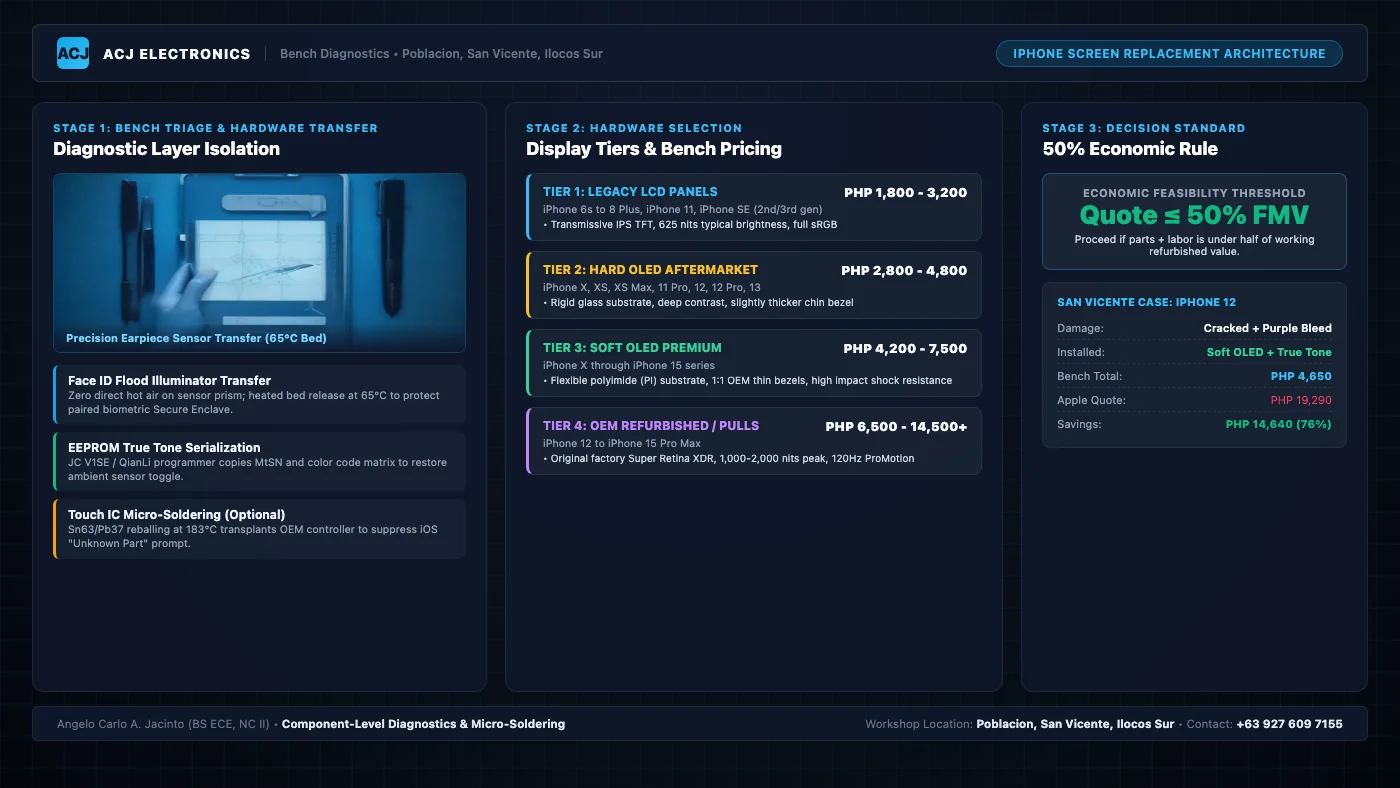
Every day at ACJ Electronics, customers ask why iPhone screen replacement estimates vary so wildly between repair shops. The price difference comes down to panel technology, glass substrate durability, and whether the technician transfers your display serialization data.
iPhone Display Hardware Tiers and Philippine Price Matrix
Here is an honest breakdown of the four primary display tiers available in the Philippine repair market, including typical parts and labor costs:
| Display Hardware Tier | Representative iPhone Models | Panel Technology and Substrate | Visual Quality and Bezel Fit | Typical Bench Range (PHP) |
|---|---|---|---|---|
| Tier 1: Legacy LCD Panels | iPhone 6s to 8 Plus, iPhone 11, iPhone SE (2nd/3rd gen) | Transmissive IPS TFT with LED backlight array | Factory-standard brightness (625 nits) and full sRGB color accuracy | ₱1,800 to ₱3,200 |
| Tier 2: Hard OLED Aftermarket | iPhone X, XS, XS Max, 11 Pro, 12, 12 Pro, 13 | Rigid glass substrate OLED emitter array | Deep blacks, high contrast; slightly thicker (0.5 mm) bottom chin bezel | ₱2,800 to ₱4,800 |
| Tier 3: Soft OLED Premium Aftermarket | iPhone X through iPhone 15 series | Flexible polyimide (PI) substrate OLED array | 1:1 OEM bezel thickness, excellent drop resilience, rich color vibrancy | ₱4,200 to ₱7,500 |
| Tier 4: OEM Refurbished / Original Pulls | iPhone 12 to iPhone 15 Pro Max | Original factory Apple Super Retina XDR panel | 1,000 to 2,000 nits outdoor peak brightness, 120Hz ProMotion on Pro units | ₱6,500 to ₱14,500+ |
Hard OLED vs Soft OLED vs INCELL LCD: Understanding the Tradeoffs
When replacing an OLED-equipped iPhone (iPhone X, XS, 11 Pro, and all iPhone 12, 13, 14, and 15 models), aftermarket options split into three distinct categories:
- INCELL LCD: This is the cheapest aftermarket option. It replaces your phone’s self-emissive OLED panel with an LCD sheet and a constant LED backlight. Because LCD panels require continuous backlight power, your battery drains 20% to 30% faster. The phone runs warmer, blacks appear dark gray, and viewing angles are limited. We advise against INCELL displays for daily drivers.
- Hard OLED: Hard OLED panels use genuine organic light-emitting diodes built on a rigid glass backing. Color saturation and contrast are excellent. However, because the glass substrate is brittle, a moderate drop that cracks the outer cover glass almost always shatters the underlying OLED panel as well, causing immediate black screen or green vertical lines. Hard OLED screens also feature a slightly thicker bottom chin bezel.
- Soft OLED: Soft OLED panels use a flexible polyimide substrate, mirroring Apple’s original factory engineering. The flexible layer curves around the bottom edge of the frame, allowing identical ultra-thin bezels. More importantly, soft OLED panels absorb shock from drops without cracking the emitter layer. If you want factory durability and vibrant color reproduction without paying full Apple authorized prices, Soft OLED is the bench recommendation.
Frame Straightening and Precision Chassis Alignment
A detail that amateur repair shops often overlook is chassis squaring. When an iPhone takes a hard corner impact that fractures the screen glass, the aluminum or stainless steel housing frequently bends or develops a raised dent at the impact point.
If a technician clamps a new glass display into a deformed frame, constant mechanical shear stress is placed on the edge of the panel. The first minor bump in your pocket will crack the replacement screen from the inside out. On our bench, we check frame flatness with a steel machinist square. We use specialized frame realignment pliers and precision dental burrs to grind away inward corner dents, ensuring the new display sits completely flush without localized pressure hotspots.
True Tone Serialization and EEPROM Transfer
Starting with the iPhone 8, Apple pairs the screen assembly to the logic board via unique serialized data stored in a small EEPROM chip on the display flex. If a technician simply swaps the screen without reading and transferring this data, iOS automatically disables the True Tone dynamic color temperature feature, and newer models display an “Unknown Part” notification in Settings.
During our bench replacements, we connect your original screen to a specialized QianLi or JCID hardware programmer, read the factory serial and matrix calibration data, and flash it onto the replacement panel’s EEPROM. This restores True Tone functionality and maintains accurate ambient color adjustment.
Face ID Preservation: The Upper Sensor Flex
The most delicate part of an iPhone screen replacement is transferring the upper earpiece speaker and sensor flex cable. This small flex assembly houses the flood illuminator and ambient light sensor, which are cryptographically paired to your iPhone’s Secure Enclave processor.
If an inexperienced technician uses excessive heat or tears this ribbon cable during disassembly, Face ID biometric recognition is permanently disabled. We use precision ESD tweezers, low-temperature heating mats set strictly to 65°C, and microscopic inspection to safely transfer the sensor array into the new display frame without compromising your device security. We then install custom die-cut adhesive gaskets to restore dust and moisture resistance.