
Senior Hardware Diagnostic Engineer and Bench Technician at ACJ Electronics
Angelo Carlo A. Jacinto is the founder, senior hardware diagnostic engineer, and bench technician behind ACJ Electronics in Poblacion, San Vicente, Ilocos Sur, Philippines. He writes, reviews, and technically validates all diagnostic workflows, repair guides, and commercial pricing models published across this website. Every technical guide on this platform reflects actual bench testing, physical circuit measurements, and component-level triage rather than theoretical regurgitation or automated summaries.
His engineering philosophy centers on disciplined diagnostic triage: identify the exact root fault first, measure circuit rails with calibrated instrumentation, explain the mechanical or electrical failure in everyday language, and help the device owner make an honest financial decision. That same practitioner standard guides every commercial service page, topic hub, and troubleshooting manual across ACJ Electronics.
Author and Engineer Profile Snapshot
- Full Name: Angelo Carlo A. Jacinto
- Current Role: Founder, Senior Hardware Diagnostic Engineer, and Bench Technician
- Organization: ACJ Electronics (Operating since 2022)
- Formal Education: Bachelor of Science in Electronics and Communications Engineering (BS ECE), St. Paul University Philippines (SPUP)
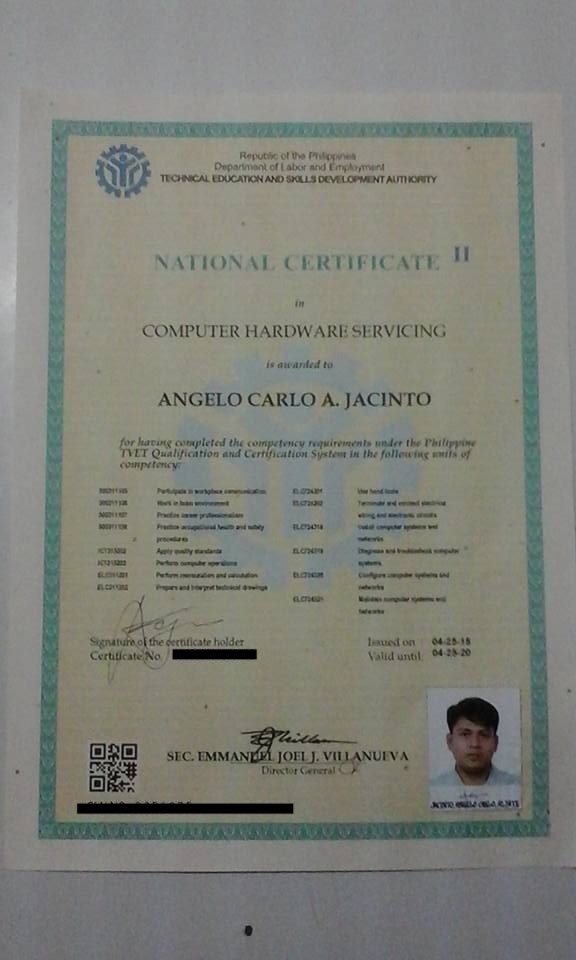
- Technical Certification: Certified Computer Hardware Servicing NC II (TESDA)
- Physical Workshop: Poblacion, San Vicente, Ilocos Sur, 2726, Philippines
- Coordinates: 17.597452507942055, 120.37318101347567
- Workshop Hours: Monday to Friday (7:30 AM to 8:00 PM), Saturday (7:30 AM to 5:00 PM), Sunday (8:00 AM to 6:00 PM)
- Direct Contact: +63 927 609 7155 | hello@acjelectronics.com
- Core Specialties: Component-level motherboard repair, switch-mode power supply triage, micro-soldering, DC-in voltage rail diagnostics, smartphone display calibration, and printer feed mechanics
Engineering Credentials, Formal Education, and Workshop Background
Angelo built his technical foundation on formal engineering training. He graduated with a Bachelor of Science in Electronics and Communications Engineering (BS ECE) from St. Paul University Philippines (SPUP). His academic curriculum focused on advanced circuit theory, semiconductor physics, signal transmission, power system design, and digital communications. This formal training provides the analytical rigor needed to read complex schematic diagrams, calculate thermal resistance values, trace multi-layer PCB power buses, and isolate signal integrity faults.
To complement theoretical circuit engineering with practical micro-assembly standards, Angelo earned his Computer Hardware Servicing NC II certification. This certified credential confirms competency in modular diagnostics, physical sub-assembly replacement, system assembly, power supply testing, and electro-mechanical maintenance.
Since founding ACJ Electronics in 2022 in Poblacion, San Vicente, Angelo has operated a daily diagnostic bench serving residents, students, and businesses across San Vicente, Vigan City, Bantay, Santa Catalina, Caoayan, and nearby Ilocos Sur communities. He handles complex hardware triage across consumer laptops, desktop computers, mobile phones, tablets, thermal receipt and inkjet printers, active audio systems, and industrial power adapters.

Core Bench Diagnostic Philosophy and Engineering Standards
Most hardware repair mistakes occur when technicians guess without measuring. Angelo enforces a four-pillar diagnostic protocol at the ACJ Electronics bench:
1. Non-Invasive Pre-Power Triage
Power should never be applied blindly to a shorted or liquid-damaged board. Every device intake begins with passive visual inspection under a stereoscopic microscope. Technicians look for cracked ceramic capacitors, charred MOSFET resin, fractured BGA solder balls, loose enclosure screws, and liquid crystallization. Before touching high-voltage circuits in printer power supplies or audio amplifiers, primary filter capacitors holding up to 400V DC are passively discharged across a 1 kΩ, 10W wirewound bleeder resistor. On battery-powered electronics, unpowered diode-mode and resistance-to-ground measurements are taken on the main DC-in and system power rails to rule out dead shorts before applying controlled bench voltage.
2. Component-Level Fault Isolation
Replacing an entire motherboard for a single shorted 0402 multilayer ceramic capacitor (MLCC) costs customers thousands of pesos unnecessarily. Angelo utilizes precision diagnostic instrumentation to pinpoint component-level failures:
- Digital multimeters in diode mode and millivolt range to evaluate semiconductor P-N junction forward voltage drops and detect rail leakage.
- Adjustable bench DC power supplies with precise current-limiting to safely energize isolated sub-circuits without vaporizing PCB traces.
- High-resolution FLIR thermal imaging to immediately identify localized heat blooms produced by failing buck converters, leaky decoupling capacitors, or degraded charging ICs under milliwatt dissipation.
- 100MHz digital storage oscilloscopes to verify crystal oscillator clock pulses, switch-mode power supply gate drive waveforms, and I2C/SPI bus communications.
- Microscope-assisted micro-soldering tools to rebuild severed copper traces, jump damaged solder pads, and replace 0201 passives or QFN micro-controllers.
3. Workmanship and Metallurgy Standards
Reliable solder joints require strict thermodynamic and metallurgical control. Angelo aligns rework practices with IPC-A-610 Class 2 and Class 3 electronic assembly standards and IPC-7711/7721 repair specifications. Solder alloys are carefully matched: modern commercial boards with SAC305 lead-free alloy (melting at 217°C) receive calibrated tip temperatures between 350°C and 380°C with non-corrosive RMA flux, while sensitive vintage boards and delicate copper pads benefit from Sn63/Pb37 eutectic alloy (melting at 183°C) at 320°C to 340°C to eliminate intermetallic embrittlement. Every repaired solder joint undergoes stereoscopic magnification check for smooth wetting angles, zero bridging, and complete flux residue removal using 99.7% electronic-grade anhydrous isopropyl alcohol.
4. Honest 50% Repair Economics
An engineer’s primary duty is honest advice. ACJ Electronics operates on a strict 50% repair economic feasibility rule: if the combined cost of certified replacement parts and specialized bench labor exceeds half the cost of purchasing a reliable, working equivalent pre-owned device, Angelo tells the customer directly to replace the equipment. Devices approaching end-of-life with multiple cascading board faults or obsolete operating system support are directed to safe salvage and data recovery rather than wasteful repair cycles.
How Angelo Writes, Researches, and Audits ACJ Content
Every article published on the ACJ Electronics website serves as an authoritative technical reference for consumers, hobbyists, and fellow technicians. Angelo reviews every page against strict editorial and technical criteria:
- Direct Symptom-to-Circuit Mapping: Guides open with direct answers (Bottom Line Up Front) outlining the root failure within the first 50 words, followed by practical bench procedures.
- Verified Bench Measurements: Content cites specific voltage rails (such as 19V DC-in, 3.3V/5V standby, 1.05V PCH, or 1.2V DDR), component package standards (0201, 0402, 0805, QFN, BGA), thermal paste conductivities (8.5–12.5 W/mK), and realistic Philippine labor and part price ranges.
- Clear Stop Boundaries: Articles clearly distinguish safe user checks (cable testing, external cleaning, port lint clearing) from dangerous operations requiring professional bench gear (swollen lithium pack extraction, 400V SMPS filter discharge, heat gun rework, and BGA reballing).
- Local Realism: Repair pricing, component sourcing logistics, and turnaround windows reflect the actual economic conditions in the Philippines.
Core Topic Hubs Directory
Angelo has architected six cornerstone topic decision hubs that organize all informational guides, diagnostic triage workflows, and cost breakdowns across ACJ Electronics:
Commercial Service Pages Directory
When remote troubleshooting indicates a component-level hardware failure, ACJ Electronics provides eight dedicated commercial repair services backed by Angelo’s engineering supervision and a 90-day workmanship warranty:
Cornerstone Diagnostic Guides and Technical Manuals
Angelo has written and published a library of deep-dive technical diagnostic manuals to help readers understand hardware failure mechanisms:
- Electronics Diagnostics & Bench Skills:
- Electronics Troubleshooting Guide: Canonical seven-step component isolation sequence for consumer electronics.
- How to Use a Multimeter for Diagnostics: Voltage rail tracing, continuity testing, and diode mode semiconductor triage.
- How to Read Electronics Schematics for Beginners: Deciphering circuit nets, reference designators, and board layout schematics.
- How to Properly Use Flux in Electronics Repair: Rosin Mildly Activated (RMA) chemistry, oxide removal, and residue cleaning.
- How to Solder: Temperature Control and Joint Inspection: Alloy metallurgy (SAC305 vs Sn63/Pb37) and IPC-A-610 inspection standards.
- Identify and Replace Common Electronic Components: Distinguishing MLCCs, inductors, diodes, transistors, and IC packages.
- Electrostatic Discharge (ESD) Protection Guide: Triboelectric dissipation, bench grounding, and MOSFET gate protection.
- Safe DIY Electronics Troubleshooting Checklist: Ten-point pre-power safety and cold DC rail measurement guide.
- DIY vs Professional Electronics Repair Decision Guide: Evaluating repair risks, tooling investments, and economic thresholds.
- Hardware Bench Evaluations and Buyer’s Guides:
- Best Multimeters for Electronics Repair Beginners: Input impedance, CAT safety ratings, and micro-probe precision metrics.
- ESD Wrist Strap and Static Dissipative Mat Review: 1MΩ series safety resistors, dual-layer NBR rubber, and surface resistivity.
- Soldering Iron Review: Active Cartridges vs Ceramic Sleeves: Comparing T12/C245 active heating with traditional 936 stations.
- Phone Repair Toolkit Review: S2 shock-resistant steel bit metallurgy, suction pliers, and ESD tweezers.
- Laptop & Storage Diagnostics:
- How to Diagnose No Power on Laptops: Tracing the 19V main bus, current sensing resistors, and 3.3V/5V standby rails.
- Laptop Not Charging: Safe Triage Before Repair: DC jack pin wear, SMBus battery telemetry, and charging IC diagnosis.
- How to Fix an Overheating Laptop: Heat pipe phase-change vacuum loss, viscous thermal paste, and fan bearing repair.
- How to Replace a Laptop Battery Safely: Li-Po pouch cell swelling, SMBus fuel gauge calibration, and safe extraction.
- Laptop Screen Replacement Cost in the Philippines: eDP 30-pin vs 40-pin panels, TN vs IPS color fidelity, and bench rates.
- Laptop Keyboard Repair Cost Guide: Membrane rivet re-staking, liquid spill corrosion, and keyboard controller ICs.
- Laptop SSD Upgrade Guide: M.2 NVMe vs SATA interfaces, sector-by-sector cloning, and thermal throttling pads.
- Best Laptop SSD Upgrade Options: TLC endurance vs QLC slowdowns, onboard DRAM cache vs HMB, and physical clearance.
- Data Recovery Cost vs Risk: TVS diode protection, head crash boundaries, and raw bit-level recovery risks.
- Smartphone & Tablet Hardware:
- iPhone Screen Replacement Cost Philippines: Display panel tiers, True Tone EEPROM serialization, and Face ID flex transfer.
- Android Battery Replacement Cost Philippines: Milliohm load testing, BMS micro-soldering, and curved glass back removal.
- Android Phone Battery Repair and Calibration: Texas Instruments BQ coulometer recalibration and pouch cell chemistry.
- Phone Charging Port Repair Guide: Type-C CC1/CC2 diode drop triage, VBUS voltage testing, and flex replacement.
- Water-Damaged Phone Repair and Recovery: Ultrasonic bath decontamination, corrosion removal, and short circuit isolation.
- How to Identify Battery Swelling and What to Do: SEI layer breakdown, organic solvent gas pressure, and safe sand disposal.
- What a Boot Loop Means on Android and iPhone: NAND storage corruption, CPU/RAM PoP BGA reballing, and PMIC drops.
- Printer & Audio Hardware:
- Printer Error Codes Basics: Optical encoder sensor cleaning, waste ink counters, and logic board transistor checks.
- Printer Paper Jam Causes and Mechanical Triage: Separation pads, D-roller friction glazing, and pick-up solenoids.
- Printer Repair Cost Philippines: EcoTank maintenance boxes, printhead descaling, and main board repairs.
- Speaker No Sound or Distortion Troubleshooting: Rubbing voice coils, degraded electrolytic caps, and Class D output stages.
Trust Signals, Workmanship Warranty, and Local Community Presence
ACJ Electronics is a locally registered, physical electronics repair business operating in Poblacion, San Vicente, Ilocos Sur. Angelo stands firmly behind every repaired device with clear operational policies:
- 90-Day Workmanship Warranty: All completed repairs carry our standard 90-day warranty covering the specific components replaced and bench labor performed. You can review full coverage parameters and exclusions on our Warranty Policy page.
- Verified Business Background: Read about our workshop history, technician team, and counter intake workflow on the About ACJ Electronics page.
- Local Service Area: Learn about our coverage across Metro Vigan and Ilocos Sur municipalities on our Service Area page.
- Verified Customer Reviews: Readers and prospective customers can review independent feedback and ratings directly on our Google Maps business listing.
Frequently Asked Questions
What are Angelo Carlo A. Jacinto’s technical qualifications and engineering credentials?
Angelo Carlo A. Jacinto holds a Bachelor of Science in Electronics and Communications Engineering (BS ECE) from St. Paul University Philippines (SPUP) and is certified in Computer Hardware Servicing NC II by TESDA. He combines formal circuit analysis, power distribution theory, and signal integrity fundamentals with daily hands-on bench repairs in Poblacion, San Vicente, Ilocos Sur.
Does Angelo Carlo A. Jacinto personally perform diagnostics and repairs at ACJ Electronics?
Yes. Angelo is the bench technician and senior hardware diagnostic engineer actively diagnosing devices at the ACJ Electronics workshop. He handles component-level isolation, voltage rail tracing, thermal camera analysis, stereoscopic microscope inspection, and precision micro-soldering on smartphones, laptops, printers, audio systems, and power supplies.
How does Angelo Carlo A. Jacinto verify the technical advice published on ACJ Electronics?
Every article, troubleshooting guide, and service page on ACJ Electronics is written or technically audited by Angelo based on real bench intake records, actual circuit schematics, and physical measurements (such as diode drops, voltage rails, and thermal throttling thresholds). He rejects generic AI summaries, textbook generalities, and unsafe DIY hacks.
What is Angelo’s 50% repair economics rule?
The 50% repair rule means that if the cost of reliable replacement parts and bench labor exceeds half the fair market value of a working equivalent pre-owned device, Angelo advises the customer to replace the unit rather than spend money on an uneconomic repair. This protects customers from over-investing in aging hardware.
How can customers and readers verify ACJ Electronics before bringing in a device?
You can inspect the workshop credentials and real bench evidence on this page, read verified customer reviews on Google Maps, review the transparent 90-day workmanship terms on our Warranty Policy page, examine our verified service radius across Ilocos Sur, or speak directly with Angelo before visiting.
Where is the ACJ Electronics physical workshop located and what are its operating hours?
The ACJ Electronics workshop is located in Poblacion, San Vicente, Ilocos Sur, 2726, Philippines. Operating hours are Monday to Friday from 7:30 AM to 8:00 PM, Saturday from 7:30 AM to 5:00 PM, and Sunday from 8:00 AM to 6:00 PM.
Consult with Angelo Carlo A. Jacinto at ACJ Electronics
If you have a malfunctioning laptop, smartphone, tablet, printer, or audio system in Ilocos Sur, or if you need expert advice on whether a device is worth repairing, reach out directly. Send the device model and symptoms for honest diagnostic guidance before you spend money on unnecessary parts or replacement units.