
Android battery replacement in the Philippines typically costs ₱800 to ₱5,500 depending on device architecture, pouch capacity, and BMS pairing requirements. In Poblacion, San Vicente, Ilocos Sur, Angelo Carlo A. Jacinto (BS ECE, NC II) provides milliohm internal resistance testing, adhesive solvent softening, and bench installation.
When an Android smartphone drains in two hours or abruptly shuts down during a phone call, owners need clear pricing and honest technical triage. Unlike desktop computers or older handsets with removable plastic rear doors, modern Android phones feature sealed glass or polycarbonate sandwich housings, high-density lithium polymer pouches, and complex power distribution circuitry. Sourcing the right replacement battery and safely installing it requires understanding component failure modes, bench safety protocols, and actual Philippine repair rates.
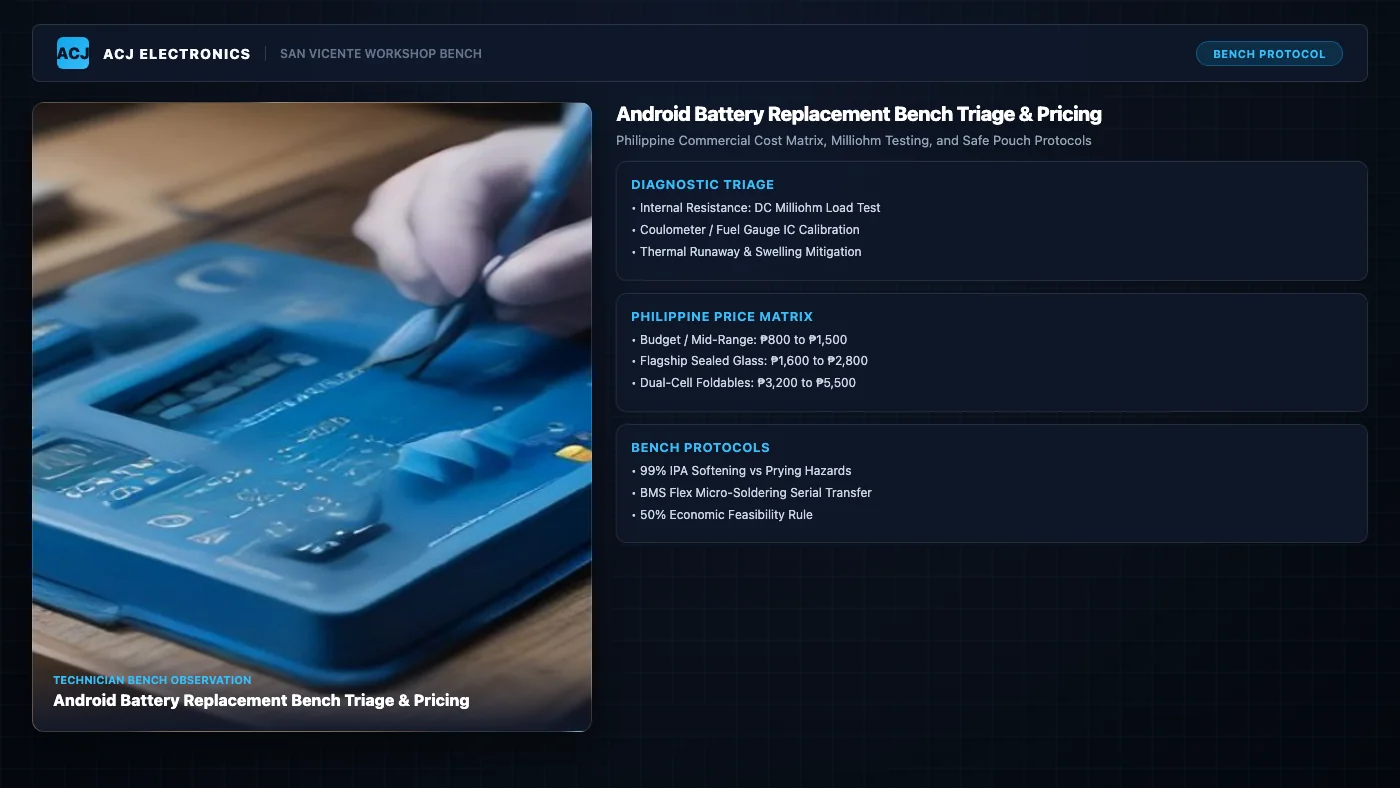
Diagnostic Triage: Identifying Battery Degradation Root Causes
Before unsealing an adhesive rear cover, an experienced hardware technician verifies whether battery chemistry is the actual root cause of power failure. Many charging or runtime symptoms stem from charging port debris, motherboard parasitic draw, or uncalibrated software fuel gauges rather than an exhausted cell. On our San Vicente workbench, we isolate battery health across three primary diagnostic layers.
1. Voltage Sag vs Milliohm Internal Resistance
A multimeter reading static terminal voltage at rest tells only part of the story. A degraded lithium pouch can show 4.15V under zero load, giving the illusion of a full charge. However, as lithium ions become trapped in inactive chemical compounds over hundreds of charge cycles, the cell internal resistance climbs sharply.
In our workshop, we measure internal resistance using a dynamic DC load test:
- Healthy Battery Baseline: A brand-new smartphone pouch typically exhibits internal resistance between 30 and 60 milliohms (mΩ). Under a 2A processor current spike, voltage drops by less than 0.12V, maintaining stable system power.
- Degraded Cell Behavior: An aged battery with over 600 cycles frequently registers internal resistance between 250 and 500 mΩ or higher. When the phone initiates a high-draw task (such as triggering an LED camera flash, connecting to a distant 5G cell tower, or launching 3D gaming), this increased internal resistance produces severe voltage sag.
- Instant Shutdown Point: When terminal voltage drops below the Power Management Integrated Circuit (PMIC) low-voltage cutoff threshold (typically 3.40V), the supervisor circuit cuts power immediately. The phone turns off abruptly, even though the battery indicator read 25% or 35% a second earlier.
If your device cuts off during heavy tasks but stays on while resting on the home screen, high internal resistance is the culprit. The pouch must be replaced.
2. Coulometer and Fuel Gauge IC Recalibration
Android smartphones track remaining power through dedicated coulometer integrated circuits (such as the Texas Instruments BQ27z561, BQ28z610, or Maxim MAX17xxx series gas gauge ICs). These microchips count milliampere-hours entering and exiting the battery, calculating State of Charge (SOC) and State of Health (SOH).
Over time, partial charging cycles, thermal exposure, and system crashes can desynchronize the fuel gauge register from actual chemical capacity. The phone may display 100% after ten minutes on a charger, or drop from 60% to 20% in seconds. Before condemning a battery, we perform a bench calibration cycle: discharging the cell to its cut-off floor under controlled current, followed by an uninterrupted 100% saturation charge, resetting the gas gauge learning table.
3. Battery Swelling and Thermal Runaway Prevention
A swollen battery is not merely an inconvenience; it represents an active mechanical and thermal hazard. When lithium pouch cells degrade through overcharging, sustained heat, or internal dendritic micro-shorts, the liquid electrolyte breaks down into hydrocarbon gases (carbon monoxide, hydrogen, and methane). This expands the flexible sealed foil pouch.
Warning signs include a raised rear cover, a screen flexing outward from the chassis frame, or a spongy feeling under thumb pressure. If your phone exhibits these signs, consult our detailed workshop guide on how to identify battery swelling and what to do. Swollen cells must never be punctured, squeezed, or heated; doing so exposes volatile lithium salts to atmospheric moisture and oxygen, triggering uncontrollable thermal runaway.
Android Battery Replacement Cost Matrix in the Philippines
Android battery replacement costs in the Philippines vary based on chassis disassembly complexity, brand parts sourcing, and whether the phone utilizes single or dual-cell power delivery. The table below outlines realistic bench repair rates across popular handset tiers in the Philippine market.
| Device Tier & Representative Models | Battery Architecture & Capacity | Bench Labor Complexity | Typical Price Band (Parts + Labor) |
|---|---|---|---|
| Budget & Mid-Range Handsets (Xiaomi Redmi, Realme, Vivo Y-series, Oppo A-series, Infinix, Tecno, Itel) |
Single pouch cell (4,500 to 5,000 mAh), standard 3.85V / 4.4V charging chemistry | Polycarbonate back plate, modular sub-board ribbon routing, straightforward pull-tab release | PHP 800 to PHP 1,500 |
| Upper Mid-Range & Performance Models (Samsung Galaxy A52 to A55, Poco F/X series, Xiaomi Redmi Note Pro, Oppo Reno) |
High-capacity single cell (4,500 to 5,000 mAh) with 33W to 67W fast-charge dual-tier BMS | Heat-assisted glass or composite rear removal, fingerprint sensor flex protection, precision perimeter re-sealing | PHP 1,200 to PHP 1,900 |
| Sealed Premium Flagships (Samsung Galaxy S21 to S24 Ultra, Google Pixel 6 to 8, OnePlus 10 to 12, Xiaomi Ultra) |
High-energy density pouch (4,800 to 5,400 mAh), wireless charging coil integration, NFC antenna overlays | Curved glass back removal at 75°C, motherboard shield removal, graphite thermal sheet preservation, OEM adhesive gasket | PHP 1,600 to PHP 2,800 |
| Foldable & Dual-Cell Architectures (Samsung Galaxy Z Flip / Fold series, Oppo Find N) |
Split dual-battery setup (two distinct pouch cells wired in parallel or series through hinge flex) | Complex disassembly of both upper and lower chassis housings, ultra-thin ribbon cable clearing, dual cell balancing | PHP 3,200 to PHP 5,500 |
Understanding Why Battery Quotes Vary
Customers often ask why replacing a battery in an entry-level Realme costs ₱950 while a Samsung Galaxy S23 Ultra runs ₱2,400. The cost difference is not arbitrary; it is driven by hardware architecture and disassembly risk:
- Enclosure Construction: Entry-level phones snap apart using plastic perimeter clips or light adhesive. Premium flagships feature chemically strengthened Gorilla Glass Victus back covers bonded with aggressive acrylic foam tape. Removing them without cracking requires uniform heating at 75°C, precision suction clamps, and solvent softening.
- Sub-Component Protection: In premium handsets, wireless charging induction coils, NFC loops, and fragile flex cables sit directly on top of the battery compartment. Rushing through disassembly can sever a ₱1,500 charging coil assembly.
- Adhesive Gasket Re-sealing: Reassembling a water-resistant phone requires scraping old adhesive residue with plastic scrapers, degreasing mating surfaces with 99% isopropyl alcohol, and applying model-specific die-cut adhesive gaskets under uniform clamp pressure.
Bench Workshop Protocols: Safe Adhesive Removal and BMS Micro-Soldering
Replacing a modern lithium polymer pouch is precision mechanical work. Because modern phones lack protective metal battery casings, improper handling can cause immediate fire or permanent motherboard failure. On our workbench in San Vicente, we strictly adhere to certified electronics bench protocols.
1. Adhesive Pull-Tab Release vs 99% Isopropyl Alcohol Softening
Most manufacturers secure lithium pouches using stretch-release adhesive strips (command-strip style tape). When pulled horizontally at a low 15-degree angle, the elastomeric tape stretches to several times its length, releasing its shear bond cleanly without mechanical prying.
However, age and tropical heat frequently dry out these tabs, causing them to snap flush against the battery frame. When this happens, inexperienced technicians make the disastrous mistake of inserting metal pry tools, screwdrivers, or razor blades underneath the battery. Prying against the pouch bends the delicate copper and aluminum current collector foils, creating internal micro-shorts that ignite the volatile electrolyte within seconds.
Our workshop protocol follows zero-pry chemistry:
- We apply four to six drops of 99.7% electronic-grade isopropyl alcohol (IPA) around the battery edges. Isopropyl alcohol penetrates beneath the pouch, chemically dissolving the pressure-sensitive acrylic adhesive without damaging surrounding plastic or motherboard traces.
- We allow two minutes for the solvent to dissolve the adhesive matrix.
- Using a wide, non-conductive plastic spudger or flexible polyimide flossing strip, we slide underneath the pouch and lift it effortlessly with negligible mechanical resistance.
- A dedicated metal safety tray and dry sand bucket remain within arm reach on the bench during every lithium extraction as a fire prevention safeguard.
2. BMS Flex Cable Micro-Soldering and Serial Transfer
Modern Android brands (including select flagship series from Samsung, Xiaomi, and Google) are increasingly adopting serialized battery protocols similar to Apple ecosystem. In these devices, the Battery Management System (BMS) circuit board at the top of the battery pouch contains an encrypted cryptographic microchip and factory calibration thermistors.
If an aftermarket battery with a generic third-party BMS is connected directly to the phone, several issues can occur:
- The operating system may generate an unrecognized battery notification or disable fast charging profiles.
- The battery temperature sensor (NTC thermistor) may provide incorrect thermal readings to the charging PMIC, causing the phone to stop charging at 40°C or refuse to charge in air-conditioned environments.
- Fuel gauge percentage tracking becomes erratic, causing unexpected drops.
To eliminate these issues, our workshop performs BMS flex micro-soldering transfer when required. Under our stereo bench microscope, we peel back the polyimide insulation tape, desolder the original BMS protection board from the depleted battery core terminals, and micro-solder the OEM board onto a fresh, certified high-capacity pouch cell using Sn63/Pb37 solder alloy at 350°C. This preserves factory thermal safety parameters, fast-charging protocols, and authentic system telemetry.
The 50% Rule: Repair vs Replacement Decision Framework
As an engineering practice, we believe in giving customers honest financial advice rather than encouraging uneconomical repairs. When a customer brings in an older smartphone with battery complaints, we evaluate the repair using our 50% economic feasibility rule:
If the total cost of the battery replacement (parts plus labor) exceeds 50% of the fair market value of an equivalent working refurbished phone, we advise against repair and recommend replacing the device.
Here is how that practical guideline applies across common Android device categories in the Philippines:
- Modern Flagships (Samsung S21 to S24, Pixel 7 to 8): High Repair Feasibility. These devices retain refurbished market values of ₱18,000 to ₱35,000 or more. Spending ₱1,800 to ₱2,500 on a fresh battery replacement represents less than 15% of the device value. With fast multi-core processors and active software update cycles, a fresh battery restores like-new performance for years of extended service.
- Mid-Range Workhorses (Redmi Note 10 to 12, Realme 8 to 10, Galaxy A52 to A54): High Repair Feasibility. Market values sit between ₱5,500 and ₱9,500. A battery replacement priced at ₱950 to ₱1,400 represents roughly 15% to 20% of the replacement cost. If the screen is intact and the storage satisfies your needs, replacing the battery is the most economical decision.
- Aging Budget Handsets (4+ Years Old, Sub-₱3,000 Value): Upgrade Recommended. If your phone is an entry-level handset from 2019 or 2020 with 32GB of eMMC storage that stutters under modern messaging apps, spending ₱1,200 on a battery replacement is rarely justified. That money is better saved toward a modern budget phone with faster UFS storage, 5G connectivity, and current Android security patches.
For broader guidance on evaluating repair feasibility across consumer electronics, consult our comprehensive frameworks on the Electronics Repair Pricing Hub and the Repair vs Replace Hub.
San Vicente Workshop Bench Case: Samsung Galaxy A52 Battery Restoration
To see how this diagnostic and repair protocol unfolds in real workshop conditions, consider an actual repair completed on our Poblacion, San Vicente bench. A customer brought in a Samsung Galaxy A52 (128GB Awesome Blue) with severe battery complaints.
Customer Symptom: The phone drained from 100% to zero in less than three hours. More critically, whenever the customer opened Shopee or launched the camera app with the battery below 40%, the device instantly froze, went pitch black, and refused to power back on until connected to a wall charger. The phone chassis also felt noticeably hot near the upper frame.
Initial Diagnostic Triage:
- We connected the phone to our bench USB power analyzer. The phone drew 8.9V at 1.62A on Samsung Fast Charging, confirming that the sub-board charging port, VBUS line, and primary PMIC were operational.
- Opening the engineering service battery telemetry menu revealed a cycle count of 782 cycles with nominal battery health estimated at 64%.
- We removed the rear composite cover on our 75°C heating bed and exposed the battery connector. Testing the original 4,500 mAh battery (model EB-BG670ABY) under a pulsed 1.5A electronic DC load revealed an internal resistance of 385 milliohms (mΩ). Under load, terminal voltage collapsed from 3.82V down to 3.24V in under 50 milliseconds, tripping the PMIC emergency low-voltage shutdown.
Bench Repair Procedure:
- We softened the factory adhesive using four drops of 99.7% isopropyl alcohol along the frame recess and removed the exhausted pouch with a plastic spudger. Zero mechanical deformation occurred.
- We sourced a certified OEM-spec 4,500 mAh replacement battery. Pre-installation bench testing confirmed an internal resistance of 42 mΩ and stable open-circuit voltage of 3.88V.
- The battery bay was cleaned of old adhesive tape, and fresh dual-strip acrylic adhesive was installed.
- We installed the new battery, reconnected the main FPC interconnect flex, re-torqued all 18 Phillips housing screws to specification, and applied a fresh die-cut perimeter adhesive gasket before clamping the rear cover.
- We performed a full fuel gauge calibration cycle, clearing historical error registers in the system gas gauge IC.
Repair Outcome and Economics: Total bench turnaround was 40 minutes. Under subsequent testing, the phone ran a continuous 1080p video stream for six hours with zero thermal throttling, operating at a cool 33°C. The sudden 35% shutdown completely disappeared. Total cost to the customer was ₱1,250 (parts, adhesive gasket, and labor included). An authorized center had quoted ₱3,400 with a five-day turnaround. The phone was returned the same afternoon, performing like a brand-new handset.
Professional Phone Diagnostics in San Vicente, Ilocos Sur
If your Android phone or iPhone suffers from sudden shutdowns, rapid battery drain, or physical swelling, professional component-level testing ensures you never pay for unnecessary repairs. From precision battery replacements with fresh adhesive gaskets to complex charging port micro-soldering and motherboard short circuit tracing, ACJ Electronics provides honest, engineering-backed bench service.
To learn more about our hardware diagnostic capabilities, explore our troubleshooting guide for water damaged phone repair, check our pricing benchmarks for iPhone screen replacement cost in the Philippines, review our diagnostic instrumentation on the Tools and Skills Hub, or explore our full smartphone services on the Phone Repair Hub and the mobile phone repair services page.