
ACJ Electronics provides component-level audio and speaker diagnostics in Poblacion, San Vicente, Ilocos Sur. Led by Angelo Carlo A. Jacinto (BS ECE, NC II), our workshop repairs voice coils, re-foams cone surrounds, troubleshoots Class-D amplifier boards, and micro-solders charging ports before any paid work begins.
When searching for an experienced speaker repair shop near me or dependable speaker repair near me in San Vicente, Vigan City, Bantay, Caoayan, or Santa Catalina, bringing your equipment to an engineering bench ensures an accurate diagnosis. For residents needing professional speaker repair San Vicente or component-level audio speaker repair Ilocos Sur, our workshop tests acoustic mechanics alongside sensitive electronics: physical cones, voice coils, suspensions, Class-D switching amplifiers, wireless radio transceivers, and high-drain power supplies. A problem that sounds like a ruined driver often originates on the circuit board, while an apparent amplifier failure is frequently caused by a fatigued voice coil lead.
If your device is an MP3 player, digital audio player (DAP), or dedicated audio recorder rather than an acoustic transducer or powered loudspeaker, visit our dedicated music player repair services for player-specific bench intake. You can also explore our sound troubleshooting guide for speaker no sound or distortion, review our comprehensive directory on the services index, compare typical costs in the Electronics Repair Pricing Hub, assess repair practicality in the Repair vs Replace Hub, and inspect our bench instrumentation in the Tools and Skills Hub.
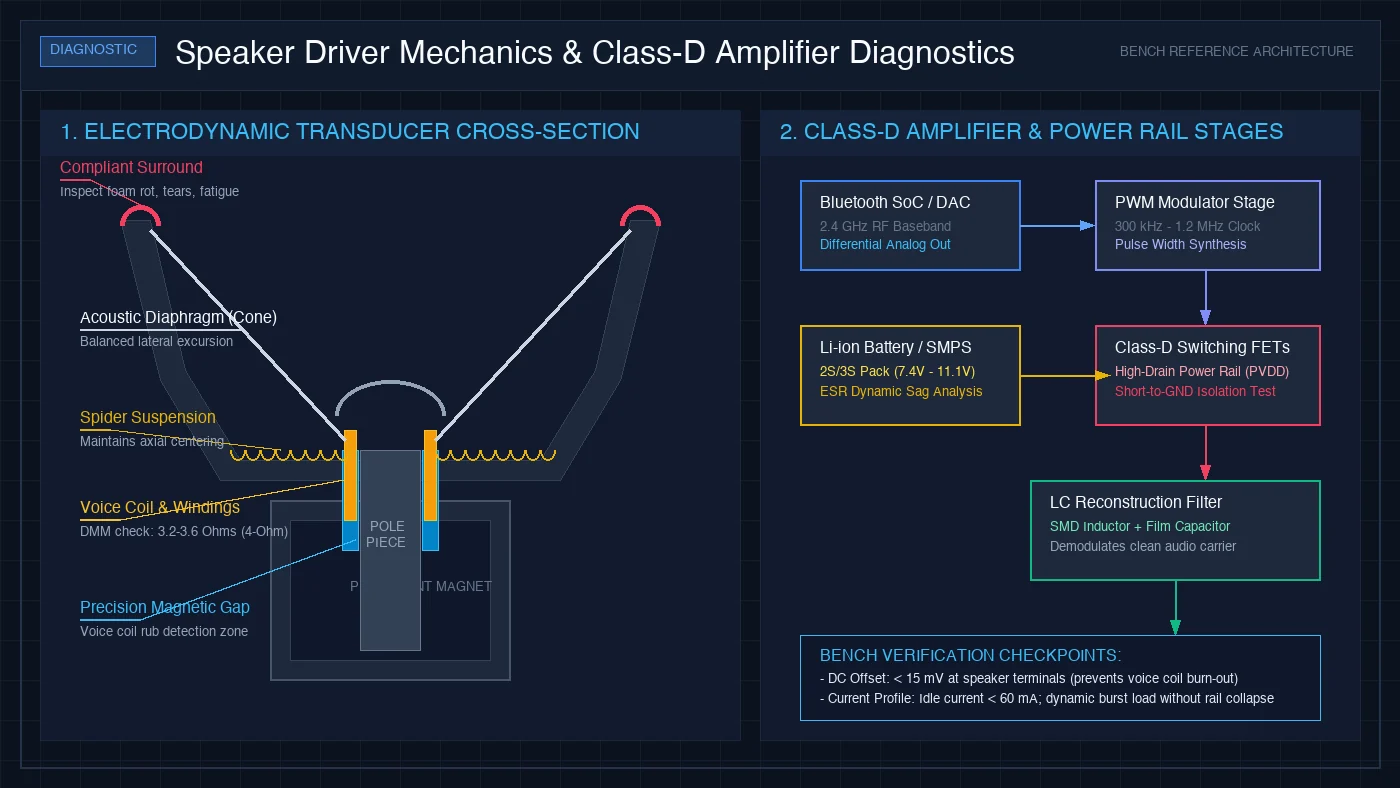
Voice Coil Rub, Cone Surround Re-Foaming, and Acoustic Driver Inspection
An electrodynamic speaker driver functions through precise electromagnetic induction. A cylindrical voice coil wound with fine copper or aluminum wire sits inside a narrow magnetic gap formed by a permanent magnet and steel pole piece. When an alternating audio signal flows through the coil, it generates a fluctuating magnetic field that repels and attracts the stationary magnet, driving the cone forward and backward to produce sound waves.
Over time, acoustic drivers suffer physical and environmental wear. In our tropical climate with high humidity and heat, the flexible surround bonding the outer cone perimeter to the metal basket basket gradually breaks down. Polyurethane foam surrounds dry out, crack, and turn to sticky powder, while rubber surrounds split along excursion folds. When the surround deteriorates, the cone loses its lateral support, causing the voice coil to tilt inside the magnetic gap. This results in voice coil rub, producing a raspy, distorted scraping sound during bass transients.
At our San Vicente workshop, we test acoustic drivers using both mechanical and electrical measurements:
- Manual Axial Deflection Check: We gently press the cone inward along its central axis using balanced fingertip pressure. If we feel friction, roughness, or audible scratching, the coil is rubbing against the magnetic pole piece.
- DC Resistance Measurement: Using a digital multimeter calibrated for low-resistance accuracy, we measure the driver voice coil DC resistance (Re). A standard 4-ohm nominal driver should measure between 3.2 ohms and 3.6 ohms, while an 8-ohm driver reads between 6.2 ohms and 7.0 ohms. An infinite resistance reading indicates an open circuit, usually a fractured copper tinsel flex lead between the terminal plate and the cone. A reading near zero ohms confirms melted coil insulation and inter-turn short circuits.
- Surround Re-Foaming and Alignment: For speakers with rotted surrounds but healthy voice coils, we remove the decomposed foam residue, dress the basket flange, and fit a compliant replacement surround. We apply a 30 Hz sine wave tone generator during adhesive curing to ensure the voice coil self-centers inside the gap without rubbing.
Class-D Amplifier Board Diagnostics and Output Stage Troubleshooting
Almost all modern portable Bluetooth speakers, soundbars, and active studio monitors rely on Class-D switching amplifiers. Unlike traditional linear Class-AB amplifiers that dissipate substantial energy as heat, Class-D topologies operate output MOSFETs as high-frequency switches (typically 300 kHz to 1.2 MHz) driven by pulse-width modulation (PWM). An LC low-pass filter composed of surface-mount inductors and metallized film capacitors filters the high-frequency switching carrier, delivering clean analog audio to the speakers.
Because Class-D circuits operate at high frequencies and high currents, board failures require systematic component-level tracing:
- Output MOSFET Short Circuits: When an amplifier is driven into severe clipping or experiences an acoustic short on the speaker line, the dual half-bridge MOSFETs inside the amplifier IC break down. This pulls the main power rail directly to ground, triggering power supply shutdown or burning surface-mount protection ferrites.
- DC Offset Voltage Check: Before connecting test drivers, we measure the DC voltage across the speaker output terminals. A healthy amplifier presents less than 15 mV of DC offset. If an amplifier outputs several volts of continuous DC, connecting a speaker will immediately overheat and destroy the voice coil.
- LC Filter Demodulation Faults: Cracked ferrite inductor cores or shorted film capacitors in the output reconstruction filter create heavy audio distortion, high idle current draw, and excessive heat dissipation even at zero volume.
- Thermal and Voltage Modulation: We inspect power rail decoupling capacitors (0805 and 1206 ceramic MLCC packages) under a stereoscopic microscope to locate micro-fractures and thermal discoloration caused by voltage spikes.
Power Supply Rail Testing and High-Drain Li-ion Battery Pack Renewal
Portable speakers require stable energy delivery to handle dynamic audio peaks. Bass frequencies demand instantaneous bursts of high current. If the power supply cannot deliver this burst power, the voltage rail sags, forcing the amplifier into severe clipping distortion or triggering the speaker micro-controller to turn off abruptly.
For portable Bluetooth speaker repair, battery degradation is one of the most frequent root causes of abnormal behavior. Manufacturers configure internal packs using dual or triple 18650 or 21700 cylindrical cells wired in series (2S or 3S configurations, delivering 7.4V to 11.1V nominal) or custom high-capacity lithium pouch cells. When these cells develop elevated internal equivalent series resistance (ESR), their terminal voltage collapses under heavy bass transients.
We test battery assemblies with calibrated electronic DC loads, measuring actual milliampere-hour discharge capacity, individual cell voltage balance, and battery management system (BMS) over-current trip points. If a cell has degraded or the BMS module has entered a permanent protection lockout, we rebuild the pack using genuine high-drain cells with matched internal resistance, spot-welding nickel strips with precision pulse welders.
For home theater subwoofers and active studio monitors, power is supplied by an internal switch-mode power supply (SMPS). We diagnose primary rectification stages, active power factor correction (PFC) ICs, switching PWM controllers, and electrolytic filter capacitors. Swollen or dried primary electrolytic capacitors cause audible 60 Hz or 120 Hz mains hum and ripple noise in the audio path.
Charging Port and AUX Connector Micro-Soldering
Portable speakers endure frequent charging cycles and outdoor transport, placing intense mechanical stress on external input ports. Repeated cable insertion, tripping over cords, or resting a speaker on its plugged-in connector leads to cracked solder joints, bent internal receptacle tongues, and lifted circuit board copper traces.
When clients bring a speaker to our shop with charging difficulties, we examine the connector under 20x to 40x magnification:
- Micro-USB and USB-C Micro-Soldering: If charging pins are loose, bent, or fractured, we remove the damaged connector using focused hot air at 340°C while shielding nearby plastic housings and rubber gaskets with polyimide heat tape. We wick old lead-free solder from the mounting pads, apply fresh rosin flux, and solder a new reinforced receptacle using SAC305 lead-free alloy. We add structural solder fillets to the chassis ground anchor tabs to withstand future twisting forces.
- Power Rail and VBUS Tracing: If the physical port is intact but the speaker draws 0.00A on our inline USB power analyzer, we trace the 5V VBUS line through transient voltage suppressor (TVS) diodes, reverse-polarity protection P-channel MOSFETs, and battery charging management ICs to isolate electrical over-stress failures.
- 3.5 mm AUX Audio Jack Servicing: Intermittent sound, audio cutting out when the cable is nudged, or missing left or right channels often trace to cracked solder joints on the 3.5 mm stereo input socket. Furthermore, oxidized internal disconnect switches can falsely signal to the audio processor that an AUX cable is inserted, muting wireless Bluetooth playback entirely. We clean, re-tension, or replace the jack assembly to restore clean input routing.
Bluetooth RF Module and Audio Input Triage
Modern wireless speakers utilize integrated Bluetooth System-on-Chip (SoC) architectures that combine a 2.4 GHz radio transceiver, baseband microprocessor, digital signal processor (DSP), and digital-to-analog converter (DAC) onto a single silicon die. When a speaker exhibits Bluetooth pairing failure, audio dropouts, or crackling wireless playback, the fault may lie in the radio stage, firmware parameters, or power delivery rails.
We systematically isolate wireless faults on our bench:
- Antenna and Matching Network Verification: Dropped speakers can crack miniature ceramic chip antennas or tear etched PCB meander-line trace antennas. We inspect RF matching capacitors and inductors to restore clean 2.4 GHz transmission range.
- Low-Dropout (LDO) Voltage Regulator Checks: The Bluetooth SoC typically operates from a dedicated 3.3V or 1.8V regulated power rail supplied by an ultra-low-noise linear regulator. If this regulator fails or outputs excessive voltage ripple, the radio processor reboots repeatedly, dropping pairing connections within seconds.
- DAC Output Signal Tracing: When a speaker connects to a phone and shows active playback but outputs dead silence, we trace the differential analog audio signals leaving the DAC pins with an oscilloscope. If audio waveforms are present at the DAC output but missing at the amplifier input, we isolate faulty mute switching transistors, coupling capacitors, or pre-amplifier operational amplifiers.
- Differentiating Source Players from Transducers: We verify whether an issue originates within the speaker receiver circuit or an external playback source. If you are experiencing issues with an independent music player rather than a speaker, consult our music player repair services for dedicated media player support.
Speaker Diagnostic and Repair Comparison Matrix
The table below outlines common speaker symptoms, probable component root causes, our bench diagnostic procedures, and realistic repair feasibility at our San Vicente workshop:
| Reported Symptom | Probable Root Cause | Bench Diagnostic Method | Repair Feasibility |
|---|---|---|---|
| Scratchy, raspy distortion on bass notes | Rotted cone surround or misaligned voice coil rubbing pole piece | Manual axial deflection test, low-frequency sweep tone generator | High (Surround re-foaming or voice coil realignment) |
| Speaker connects to Bluetooth, but output is dead silent | Blown Class-D amplifier IC, active mute circuit, or broken tinsel wire | Oscilloscope signal tracing at DAC output, DC resistance DMM check | High (Amplifier IC replacement or tinsel lead micro-soldering) |
| Speaker shuts down instantly when volume is turned up | Aged battery pack with high internal resistance (ESR) or tripping BMS | DC load discharge testing, real-time voltage sag monitoring | High (High-drain cell replacement and pack rebuild) |
| Loud 60 Hz or 120 Hz buzzing hum from subwoofer or monitor | Drying or swollen electrolytic filtering capacitors in SMPS supply | In-circuit ESR meter testing, AC ripple voltage scope verification | High (Low-ESR electrolytic capacitor replacement) |
| Charging cable must be held at an angle to charge | Fractured solder joints or broken internal tongue on USB-C/micro-USB port | Stereoscopic microscope inspection, inline USB power meter draw test | High (Receptacle micro-soldering and anchor reinforcement) |
| Sound cuts out on one channel during AUX playback | Cracked solder joints on 3.5 mm jack or oxidized internal leaf switch | Continuity testing across jack pins, stereo audio probe signal check | High (Jack reflow, contact cleaning, or socket replacement) |
Case Study: High-Output Portable Speaker with Bass Distortion and Sudden Shutdown
| Diagnostic Stage | Technical Findings and Measurements | Bench Action and Result |
|---|---|---|
| Customer Intake | A customer brought in a popular high-output portable Bluetooth speaker. At low volume, the unit played normally, but when the volume exceeded 45%, the speaker produced harsh rattling distortion and shut off completely within two seconds. | The client suspected a blown speaker driver and requested a driver replacement quote. We logged the unit for comprehensive bench diagnostics before ordering any parts. |
| Acoustic & Mechanical Triage | Removed the protective fabric grille and inspected the dual 3-inch bass drivers. The left driver surround had separated along a 35 mm split near the top basket rim. | Manual deflection confirmed slight voice coil rubbing caused by the torn surround allowing off-axis excursion. DC coil resistance measured 3.4 ohms on both drivers, confirming voice coils were intact. |
| Electrical & Battery Testing | Connected the internal 2S lithium battery pack to an electronic DC load. Under a 3A load spike simulating a heavy bass transient, the battery voltage plummeted from 8.1V down to 5.6V. | This sharp voltage drop tripped the BMS under-voltage lockout circuit, causing the power supply to reboot. The sudden shutdown was caused by battery cell degradation, not driver failure. |
| Component Rework & Rebuild | Cleaned away the deteriorated surround adhesive on the left woofer basket using solvent swabs. Installed a compliant replacement rubber surround, centering the voice coil with a 35 Hz test tone. | Rebuilt the internal battery pack with two brand-new high-drain 18650 cells rated for 15A continuous discharge. Welded pure nickel interconnect strips and verified BMS thermal protection. |
| Final Assembly & Validation | Reassembled the enclosure with fresh acoustic airtight sealing gaskets. Ran continuous audio playback tests at 85% volume across Bluetooth and AUX inputs for two hours. | The speaker delivered crisp, powerful bass without rattle, distortion, or power cutoffs. The customer paid for a surround repair and battery renewal at a fraction of the cost of new equipment. |
The 50 Percent Rule: Practical Audio Repair Decisions
We believe in honest, practical repair economics. Before undertaking any work, we evaluate your audio equipment under a clear 50 percent decision standard: if the total cost of verified replacement components and skilled bench labor exceeds half the market price of an equivalent functional speaker, we tell you frankly to replace the device rather than repair it.
Most component-level speaker services offer exceptional financial value. Re-foaming cone surrounds, renewing rechargeable battery packs, micro-soldering damaged charging ports, and replacing shorted Class-D amplifier ICs typically cost far less than purchasing a new branded Bluetooth speaker or active monitor. Conversely, if an inexpensive mass-market mini speaker has a burnt voice coil, water-damaged logic board, and cracked enclosure, replacement is the more sensible financial decision.
Before making a decision, review our standard repair rate tiers in the Electronics Repair Pricing Hub, or explore our assessment guide in the Repair vs Replace Hub.
Speaker Intake and Workshop Logistics in San Vicente
ACJ Electronics welcomes audio equipment drop-offs at our main workshop in Poblacion, San Vicente, Ilocos Sur. We provide component-level speaker repair services for clients throughout San Vicente, Vigan City, Bantay, Santa Catalina, Caoayan, and neighboring municipalities in Ilocos Sur.
When dropping off your speaker for diagnostics, please bring the speaker unit itself. If your speaker uses a proprietary DC wall charger or external power brick, please include it so we can test the entire charging chain. For standard USB-C or micro-USB powered units, you do not need to bring cables. If you are bringing passive home speakers, you only need to bring the affected cabinet or driver.