
Speaker no-sound or distortion stems from voice coil rubbing, blown Class D amplifier stages, dried power supply filter capacitors, or faulty Bluetooth DAC routing. Distinguishing physical acoustic driver failure from amplifier breakdown or pairing glitches requires isolating voice coil DC resistance, amplifier DC offset, and power rail ripple.
When an active soundbar, studio monitor, or portable Bluetooth speaker suddenly stops playing or emits raspy, garbled distortion, owners often assume the driver cone is blown. While physical speaker damage is common, audio reproduction depends on an integrated electro-acoustic signal chain. Audio originates at the source, converts through a digital-to-analog converter (DAC) or Bluetooth system-on-chip (SoC), amplifies through Class D or linear output stages, and converts into kinetic acoustic waves via voice coil electromagnetic induction.
A failure at any single point in this path can produce identical symptoms: total silence, muffled playback, or scratching distortion. On my workbench at ACJ Electronics in Poblacion, San Vicente, Ilocos Sur, methodical component-level triage isolates whether the defect resides in the transducer assembly, the solid-state amplifier board, or the low-voltage power supply rails before any parts are replaced.
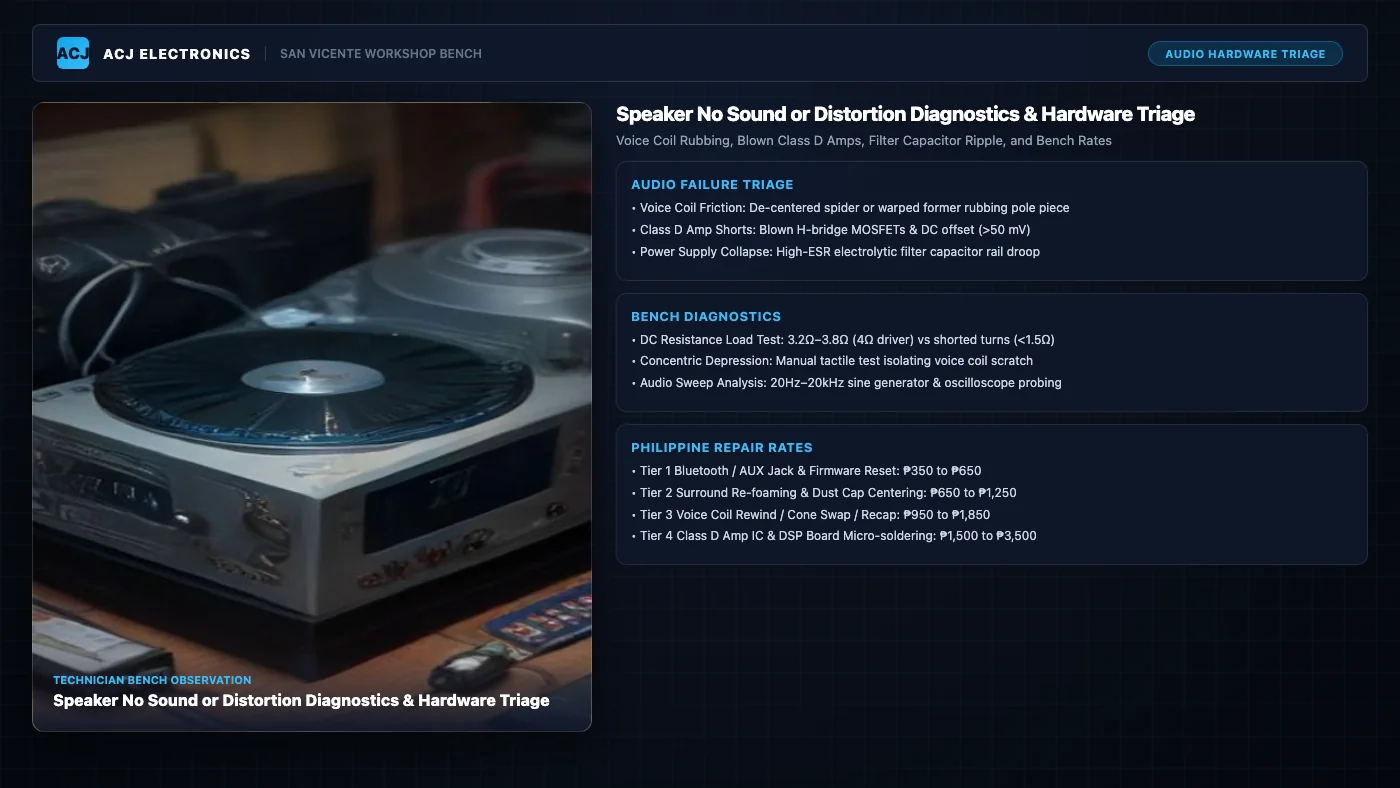
The Four Core Audio Hardware Failure Modes
While consumer audio gear ranges from compact pocket speakers to multi-driver soundbars and high-fidelity monitors, bench diagnostics identify four primary hardware failure modes responsible for audio loss and severe harmonic distortion.
1. Voice Coil and Cone Assembly Damage
The loudspeaker transducer converts alternating electrical current into acoustic air pressure. A cylindrical voice coil wound with fine enamelled copper or aluminum wire sits suspended within a narrow magnetic air gap between the neodymium or ferrite center pole piece and the top plate. When overdriven or exposed to physical shocks, this mechanical assembly degrades rapidly.
- Voice coil rubbing and friction: The voice coil former (made of Kapton, aluminum, or treated paper) must remain perfectly concentric within a gap of just 0.2 mm to 0.4 mm. If the corrugated fabric spider sags due to humidity, or excessive heat warps the cylindrical former, the coil physically rubs against the steel pole piece. This friction causes distinctive abrasive, sandpaper-like scratching distortion, most noticeable at low volumes where bass excursions occur.
- Thermal burnout and open circuits: When an amplifier is driven into severe square-wave clipping, the voice coil absorbs continuous average electrical power rather than dynamic peaks. The enamelled wire insulation melts at temperatures exceeding 200°C, shorting adjacent winding layers. Continued overheating severs the winding wire entirely, creating an open circuit (infinite resistance) and complete driver silence.
- Tinsel lead fracture: High excursion causes metal fatigue on the flexible braided copper tinsel leads connecting the terminal block to the moving cone. Fractures near the cone eyelet cause intermittent cutouts that crackle during heavy bass transients.
- Surround dry rot and tears: In tropical Philippine climates, polyurethane foam surrounds degrade through hydrolysis within five to eight years, turning sticky and crumbling away. Nitrile rubber surrounds can tear along the roll perimeter from over-excursion. A compromised surround allows air to chuff through cabinet seams, removes critical cone restoring compliance, and allows the voice coil to tilt and strike the magnetic pole piece.
2. Class D and Linear Amplifier IC Failures
Modern portable speakers and soundbars rely almost exclusively on high-efficiency Class D pulse-width modulation (PWM) switching amplifiers, including industry-standard monolithic ICs such as the Texas Instruments TPA3116 and TAS5630, or the STMicroelectronics TDA7498. Legacy active monitors and high-end sound systems utilize linear Class AB discrete push-pull stages. Both amplifier architectures exhibit specific failure symptoms.
- H-Bridge MOSFET short circuits: Class D amplifiers drive speakers through bridge-tied load (BTL) output topologies using four internal MOSFETs. When over-voltage transients, impedance dips, or poor thermal dissipation strike the board, high-side or low-side MOSFETs puncture into a permanent short. The chip either locks into immediate thermal shutdown or triggers power supply overcurrent protection, causing the entire speaker to shut down the moment it powers on.
- DC offset voltage leakage: In a balanced audio amplifier, resting direct current across speaker terminals must remain near zero (typically under 15 mV). If output transistors or BTL feedback networks drift, DC offset can exceed 50 mV to several volts. Constant DC offset biases the driver voice coil permanently out of its magnetic center, producing heavy asymmetrical second-harmonic distortion. Severe DC offset exceeding 1V will incinerate a voice coil in minutes.
- Thermal cycling shutdown: Dried thermal interface compound between the amplifier power pad and the internal aluminum heatsink causes rapid thermal throttling. The internal thermal sensor trips at 150°C, cutting audio output until the die cools down, resulting in speakers that mute every few minutes during playback.
3. Power Supply and Electrolytic Capacitor Degradation
Audio amplifiers require stiff, ripple-free direct current to reproduce dynamic audio peaks. Active speakers and soundbars utilize internal switch-mode power supplies (SMPS) or external 12V to 24V DC adapters, while portable units rely on high-drain lithium-ion battery packs.
- High Equivalent Series Resistance (ESR) in filter caps: Electrolytic capacitors in the secondary rectification stage smooth the high-frequency switching ripple. Prolonged heat inside sealed speaker cabinets evaporates liquid electrolyte, increasing ESR from 0.05Ω to 4Ω or higher. Under heavy bass transient demands, high ESR prevents the capacitors from delivering burst current, causing deep supply rail voltage dips and harsh clipping distortion.
- Mains ripple and grounding hum: If full-wave rectifier filtering capacitors in a soundbar or powered subwoofer dry out, 120Hz rectified DC ripple bleeds directly into the amplifier rails, producing an intrusive low-frequency hum that remains constant regardless of the volume knob setting.
- Lithium-ion battery internal resistance sag: In portable Bluetooth speakers, degraded battery cells with high internal resistance (>150 mΩ) drop terminal voltage under dynamic loads. When the amplifier attempts to draw 3A to 5A during a bass drop, the battery voltage sags below the undervoltage lockout (UVLO) limit, causing the speaker to power off or reboot abruptly.
4. Bluetooth Audio SoC, DAC, and Preamp Routing
A significant percentage of speaker issues diagnosed as amplifier failures actually originate in the digital audio receiver or low-noise preamplifier stages.
- Digital audio interface failures: Modern Bluetooth audio SoCs (such as Qualcomm CSR8675 or Actions ATS2825) receive wireless RF data and output uncompressed digital audio over an inter-IC sound (I2S) bus comprising bit clock (BCLK), word select (LRCLK), and serial data (SDATA) lines. Broken traces or cold solder joints on these high-speed lines cause digital crackling, periodic mute cycling, or total silence despite successful Bluetooth pairing.
- Corrupted DSP volume registers: Bluetooth SoCs store audio equalization profiles and master volume tables in non-volatile EEPROM memory. Voltage drops during firmware updates can corrupt volume registers, locking digital attenuation at -inf dB so no audio reaches the DAC.
- Physical AUX and optical jack fatigue: Repeated cord strain cracks 3.5mm stereo input jack solder joints, severing the ground or analog signal lines. Optical TOSLINK receiver modules in soundbars can suffer from clouded lenses or degraded photodiode sensors that fail to lock onto S/PDIF bitstreams.
Component-Level Bench Diagnostics and Audio Triage
When an audio unit arrives at ACJ Electronics in San Vicente, I avoid powered tests until fundamental unpowered impedance checks verify the safety of connected transducers and amplifier rails. The following testing sequence isolates audio faults reliably.
| Audio Symptom | Root Hardware Fault | Bench Test Method | Resolution & Scope |
|---|---|---|---|
| Total silence on all inputs | Open voice coil, blown mainboard fuse, or shorted Class D IC | Multimeter DC resistance check on driver terminals; power rail voltage injection | Voice coil rewind / driver swap; SMD micro-fuse or amplifier IC replacement |
| Persistent 60Hz/120Hz hum | Dried electrolytic smoothing capacitors or broken chassis ground | In-circuit ESR meter testing; oscilloscope ripple measurement on DC bus | Power supply recap with low-ESR 105°C capacitors; ground trace repair |
| Raspy distortion at low volume | Voice coil rubbing pole piece or torn spider/surround alignment | Tactile concentric cone depression; 40Hz pure sine wave generator sweep | Driver re-foaming, spider realignment, or replacement voice coil assembly |
| Audio cuts off at high volume | Battery internal resistance sag, dried rail caps, or shorted voice coil turns | Dynamic DC load testing of battery; voice coil milliohm resistance check | High-drain battery cell renewal; voice coil replacement; filter cap overhaul |
| Severe distortion on one channel | DC offset voltage leakage or saturated output LC low-pass filter inductor | Multimeter DC millivolts test across speaker terminals; LCR inductance check | Class D BTL amplifier IC micro-soldering; output filter ferrite toroid replacement |
Step 1: Unpowered Driver Voice Coil DC Resistance
Disconnect at least one wire lead from the speaker driver terminal to eliminate parallel circuitry. Set a calibrated digital multimeter to low resistance mode:
- Nominal 4Ω driver: Measures between 3.2Ω and 3.8Ω DC resistance (Re). This is normal.
- Nominal 8Ω driver: Measures between 6.5Ω and 7.5Ω DC resistance. This is normal.
- Shorted coil turns: Measures under 2.0Ω on a 4Ω driver (e.g., 1.2Ω or 0.8Ω). Melted enamel insulation has shorted windings together. This driver will draw excessive current and trip amplifier overcurrent protection.
- Open circuit: Multimeter reads infinite ohms (OL). The winding or tinsel lead is severed.
Step 2: Manual Concentric Friction Test
With the speaker driver unpowered, place two or three fingertips symmetrically around the center dust cap. Apply gentle, perfectly balanced downward pressure to displace the cone by 2 mm to 4 mm. The motion must feel smooth, cushioned by air and spider compliance, with zero sound.
Any scratchy tactile sensation or sandpaper-like sound confirms that the voice coil former is rubbing against the magnetic pole piece. If rubbing is detected, no amount of amplifier tuning or EQ adjustment will cure the distortion; the driver must be re-foamed, realigned, or replaced.
Step 3: DC Offset Voltage Verification
Reconnect the driver or attach a non-inductive 4Ω or 8Ω 50W power resistor across the amplifier output terminals. Power on the amplifier with volume at zero and no input signal connected. Measure DC voltage across the speaker terminals with a digital multimeter set to millivolts (mV):
- Under 15 mV: Excellent balance. The output stage is stable.
- 15 mV to 50 mV: Acceptable for budget equipment, but indicates mild semiconductor drift.
- Above 50 mV: Faulty output stage. The amplifier is leaking dangerous DC current into the voice coil. The amplifier IC or discrete driver transistors must be repaired before reconnecting speaker drivers.
Step 4: Sine Wave Generator and Oscilloscope Sweep
Connect an audio function generator to the AUX input and inject a pure sine wave signal. Attach an oscilloscope probe across the dummy load. Perform a sweep from 20Hz to 20kHz:
- Clipping distortion: Flat tops and bottoms on the sine wave indicate that the audio signal is exceeding the power supply rails or the power supply voltage is sagging under load.
- Crossover distortion: Visible notches or steps near the zero-crossing line indicate biased-off output transistors in Class AB circuits.
- Harmonic distortion and parasitic oscillation: Fuzzy sine wave traces or high-frequency bursts indicate instability in the amplifier feedback loop or failing output LC filter capacitors.
Step 5: Class D Output LC Filter Inspection
Class D amplifiers switch at 300kHz to 1.2MHz. A two-pole low-pass LC filter (ferrite inductor and metallized film capacitor) strips this high-frequency PWM carrier wave before audio reaches the speaker. Under thermal stress, ferrite bead cores saturate, losing inductance and allowing carrier wave energy to reach the speaker terminals, causing extreme driver heating and harsh intermodulation distortion. Inspect inductors for discolored enamel and test film capacitors for capacitance drift using an LCR bridge meter.
Philippine Commercial Audio Repair Price Matrix
At ACJ Electronics, pricing is transparent and based on diagnostic evaluation, required replacement components, and bench micro-soldering time. Below are typical commercial repair rates across major brands in the Philippines, including JBL, Harman Kardon, Sony, Marshall, and Bose.
| Service Tier | Hardware Fault Scope | Bench Work Carried Out | Typical Bench Cost (PHP) |
|---|---|---|---|
| Tier 1: Basic Audio & Input Triage | Loose AUX jack, cracked solder joints, Bluetooth antenna fatigue, volume EEPROM glitch | Reflow 3.5mm jack terminals with Sn63/Pb37 solder, clean contacts with DeoxIT, reset SoC registers | ₱350 to ₱650 |
| Tier 2: Acoustic Suspension & Re-Foaming | Rotted foam surround, torn rubber edge, loose dust cap, cabinet air leak chuffing | Strip old adhesive, align voice coil with plastic shims, bond new high-compliance foam surround | ₱650 to ₱1,250 |
| Tier 3: Transducer Overhaul & Recapping | Burnt voice coil winding, fractured tinsel leads, dried electrolytic crossover capacitors | Replace voice coil and spider assembly, install new tinsel leads, recap crossover network | ₱950 to ₱1,850 |
| Tier 4: Circuit Board & Class D Micro-soldering | Shorted Class D amplifier IC, burnt inductors, SMPS power rail collapse, DSP SoC failure | Hot-air desoldering of QFN/HTSSOP amplifier IC, track repair, install low-ESR 105°C capacitors | ₱1,500 to ₱3,500 |
The 50% Economic Repair Feasibility Rule
I advise customers against pouring money into equipment when a repair does not make financial sense. We adhere strictly to the 50% economic repair rule: if the complete cost of certified replacement components and precision bench labor exceeds half the current replacement value of a working equivalent unit, replacement is the better choice.
For budget portable Bluetooth speakers costing under ₱1,500 brand new, professional bench repairs are rarely economical. Sourcing replacement drivers and dedicating bench time pushes repair costs past ₱700 to ₱1,000, which approaches the price of a brand-new speaker with a fresh factory warranty.
However, premium portable speakers, home soundbars, and powered PA units costing between ₱7,500 and ₱25,000 (such as the JBL Charge and Boombox series, Harman Kardon Onyx, Marshall Stanmore and Kilburn, Sony party speakers, and Bose SoundLink) are outstanding repair candidates. Restoring a damaged voice coil, re-foaming a driver surround, or replacing a shorted Class D amplifier IC typically costs between ₱950 and ₱1,850. This represents just 12% to 25% of the replacement price, saving owners thousands of pesos while preserving original high-fidelity acoustic performance.
Bench Case Study: Restoring a Distorted JBL Charge 4 in San Vicente
A client from Poblacion, San Vicente brought in a JBL Charge 4 portable Bluetooth speaker. The speaker powered on and paired over Bluetooth, but emitted severe raspy, buzzing distortion on bass notes. When volume exceeded 60%, the speaker cut off completely with a harsh pop and shut down.
I began bench diagnosis by disassembling the chassis and performing unpowered driver testing. Tactile concentric depression of the primary racetrack woofer revealed noticeable sandpaper-like binding against the pole piece. A digital multimeter measurement across the woofer terminals showed a DC resistance of only 1.8Ω, compared to the factory nominal rating of 3.6Ω. The voice coil had overheated, melting enamel insulation and shorting multiple winding layers together.
When the client played music at low volume, the amplifier managed to drive the reduced impedance. However, once volume reached 60%, the 1.8Ω shorted coil demanded excessive current from the monolithic Class D amplifier IC. The amplifier internal overcurrent protection (OCP) circuit immediately tripped, shutting down the power rail to protect the silicon die.
I removed the damaged woofer, stripped the deteriorated suspension, and installed a matched factory-spec voice coil former assembly with a fresh high-excursion rubber surround. The amplifier board was thoroughly cleaned with 99.7% anhydrous isopropyl alcohol, and the internal heatsink thermal interface was refreshed. A 20Hz to 20kHz sine sweep confirmed clean, unclipped output up to 100% volume with zero rubbing. The complete repair cost the client ₱1,150, saving ₱7,849 compared to buying a replacement JBL Charge 5 (₱8,999 retail).
Professional Audio Diagnostics and Bench Intake in Ilocos Sur
If your portable Bluetooth speaker, soundbar, or powered monitor has lost audio or suffers from raspy distortion, avoiding continuous power cycling prevents shorted voice coils from damaging expensive amplifier ICs. Bring your unit to ACJ Electronics in Poblacion, San Vicente, Ilocos Sur for systematic bench triage.
Explore our dedicated service and resource hubs for additional diagnostic workflows and transparent parts-plus-labor pricing:
- Speaker Repair Services: Full driver re-foaming, voice coil replacement, and amplifier board servicing.
- Music Player Repair Services: High-resolution digital audio player DAC, battery, and headphone jack repairs.
- Electronics Repair Pricing Hub: Complete breakdown of diagnostic fees and parts formulas across electronics categories.
- Repair vs Replace Hub: Mathematical guidance and depreciation rules for repairing versus replacing consumer hardware.
- Tools and Skills Hub: Bench instruments, multimeters, oscilloscopes, and soldering protocols used in our workshop.
- Electronics Troubleshooting Guide: Core diagnostic workflows for tracking power and signal faults in electronic circuits.