Water-damaged phone repair in the Philippines costs between ₱550 for ultrasonic chemical decontamination and ₱9,500 for emergency logic board data extraction. Never put a wet phone in rice or plug it into a charger. Disconnecting the battery and professional alcohol cleaning provides the highest recovery success rate.
Liquid accidents happen in a fraction of a second. A smartphone slips into a sink, drops into a swimming pool, or falls into the ocean along the Ilocos coastline. What happens in the next sixty minutes determines whether that phone can ever be revived or if its data is lost permanently.
Most people react to water damage with panic, outdated internet myths, and deadly electrical mistakes. Modern smartphones run at high energy densities. Even when your phone screen appears black and asleep, the internal lithium battery continues sending 3.7V to 4.2V across the entire motherboard. The moment water penetrates the housing, that live voltage transforms harmless moisture into an aggressive chemical bath. Understanding how corrosion works at the circuit board level allows you to take the right emergency actions before permanent destruction occurs.
Commercial Water-Damaged Phone Repair Costs in the Philippines
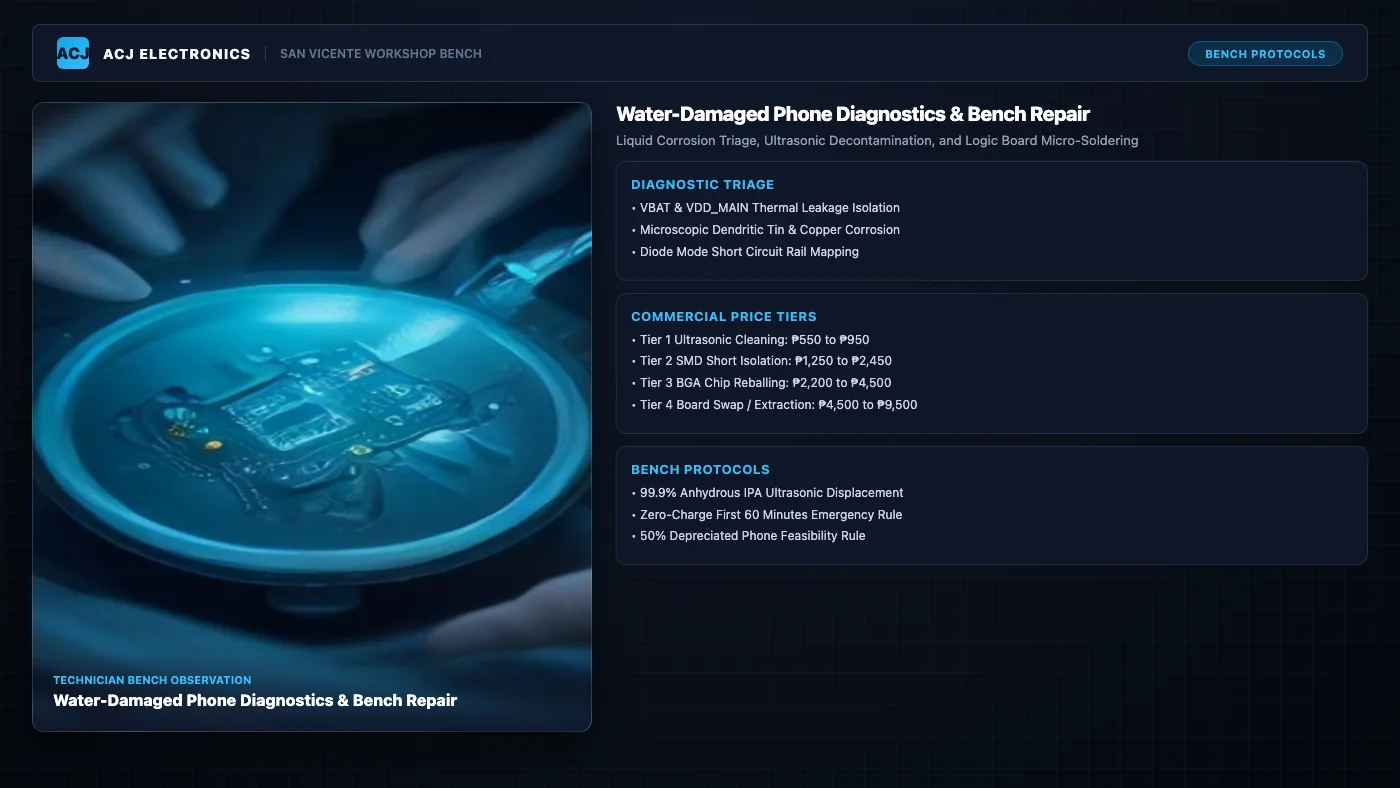
Repair costs for water damage vary widely depending on how quickly the phone was turned off, whether it was connected to a charger, and the chemical composition of the liquid. We divide liquid damage servicing into four transparent bench tiers.
| Repair Service Tier | Philippine Price Range | Typical Hardware Scope | Turnaround Time |
|---|---|---|---|
| Tier 1: Ultrasonic Decontamination | ₱550 to ₱950 | Teardown, shield removal, 99.9% anhydrous IPA sweep, oven drying at 60°C | 2 to 4 hours |
| Tier 2: Component Short Isolation | ₱1,250 to ₱2,450 | Thermal imaging, replacing shorted 0201/0402 capacitors, diodes, and power filters | 1 to 2 business days |
| Tier 3: BGA Micro-Soldering & ICs | ₱2,200 to ₱4,500 | Desoldering corroded BGA chips (PMIC, audio codec, backlight IC), reballing at 220°C | 2 to 4 business days |
| Tier 4: Board Swap & Data Extraction | ₱4,500 to ₱9,500 | CPU, NAND flash, and EEPROM transplant to donor board for critical data recovery | 3 to 7 business days |
For a comprehensive comparison of parts rates across all mobile hardware repairs, consult our Electronics Repair Pricing Hub.
Tier 1: Ultrasonic Chemical Decontamination and Thermal Desiccation
When a customer brings in a phone within hours of water exposure, extensive micro-soldering is often completely unnecessary. However, simple air drying will never remove conductive mineral deposits trapped beneath factory RF shielding cans.
In Tier 1 service, our technicians fully disassemble the handset down to the bare circuit board. We remove the battery, cameras, display panel, and desolder or unclip the protective metal electromagnetic shielding cans. The bare board is submerged in an ultrasonic cleaning bath filled with electronic-grade 99.9% anhydrous isopropyl alcohol. High-frequency ultrasonic sound waves (40kHz) generate microscopic cavitation bubbles that scrub beneath surface-mount chips, dissolving mineral salts and displacing trapped water. The board is then placed inside an ESD-safe drying chamber at 60°C for two hours. This service costs ₱550 to ₱950 and restores complete functionality in over 80% of early-intake freshwater cases.
Tier 2: Component-Level Short Isolation and SMD Passive Replacement
If the phone was turned on or plugged into a charger while wet, electrical shorts inevitably develop. High-voltage rails cause surface-mount ceramic decoupling capacitors (measuring only 0.6 mm by 0.3 mm) to fracture, bridge internally, and short directly to the system grounding plane.
Technicians use digital multimeters in diode mode combined with high-resolution FLIR thermal cameras to trace current leakage across primary power rails like VDD_MAIN, VDD_BOOST, and VPH_PWR. The shorted component glows brightly on the thermal imager under low bench voltage injection. Using micro-soldering tweezers and focused hot air at 330°C, the technician desolders the damaged capacitor or ferrite bead and solders an identical component from an OEM donor board. This precision work costs between ₱1,250 and ₱2,450.
Tier 3: BGA Reballing and Subsystem IC Replacement
Ball Grid Array (BGA) integrated circuits have dozens or hundreds of microscopic solder spheres hidden underneath the silicon chip. Surface tension pulls liquid directly beneath these chips. Once mineral-rich water enters the gap, it forms tin-lead or tin-copper dendrites, bridging adjacent power and data balls.
In Tier 3 service, the technician applies tacky rosin flux, heats the affected BGA chip (such as the main Power Management IC, display backlight driver, or audio codec) to 220°C, and lifts it off the board with vacuum suction. The circuit pads are wicked clean with copper desoldering braid. The chip is either replaced or reballed using precision laser stencils and 0.20 mm to 0.35 mm solder spheres. This advanced micro-soldering repair costs between ₱2,200 and ₱4,500.
Tier 4: Emergency Logic Board Swapping and Critical Data Extraction
When a phone has been submerged in saltwater or left wet for weeks, severe galvanic corrosion completely dissolves the internal copper routing layers of the fiberglass circuit board. The board PCB itself becomes structurally unrestorable.
If the customer requires irreplaceable business files, family photos, or encrypted database records, we execute a micro-soldering board transplant. The application processor (CPU), encrypted NAND flash storage chip, and paired EEPROM security chip are carefully milled or desoldered from the corroded board and soldered onto a known-good donor board. Once boots are established, all user data is safely cloned to external storage. For details on data retrieval safety, see our guide on Data Recovery Cost vs Risk.
The Rice Myth Debunked with Physics and Chemistry
The most common advice found on social media is to bury a wet phone in a bowl of uncooked white rice. In our San Vicente workshop, we see phones destroyed by this advice almost every week.
Why Rice Does Not Dry Electronics
Uncooked white rice is a weak desiccating agent. It has low hygroscopic capacity compared to true silica gel. More importantly, rice only absorbs moisture that has already evaporated into the air surrounding the outside of the phone casing. It has zero mechanical ability to draw liquid out from narrow cavities or pull trapped moisture out from beneath soldered metal RF shields.
Furthermore, rice grain bags are coated in fine talc and starch powder. This powder enters the charging port, speaker grilles, and microphone channels, combining with the moisture inside to create a sticky, acidic paste that clogs ports and accelerates component corrosion.
The Danger of the False Sense of Security
The greatest danger of the rice trick is the wasted time it creates. Customers leave their phone sitting in rice for 24 to 48 hours thinking the device is curing. During those two days, water trapped against live battery rails continuously corrodes delicate copper traces. By the time the customer removes the phone from the rice and finds it dead, the internal circuit tracks have completely dissolved.
The Critical First 60 Minutes: Emergency Triage Protocol
If your phone comes into contact with liquid, what you do immediately determines whether the board survives:
- Power Off the Device Instantly: If the screen is on, shut it down immediately. Do not check notifications, test the camera, or play audio. If the screen is black, do not attempt to turn it on.
- Never Plug In a Charger: Connecting a 5V or 9V charger sends high electrical current surging through wet components, creating immediate arc burns and vaporizing micro-traces. If your port was wet, read our guide on Phone Charging Port Repair for connector inspection tips.
- Remove the Protective Case and SIM Tray: Strip off thick rubber cases that trap water against the phone frame. Pop out the SIM tray to allow an air vent for moisture to escape.
- Pat Dry with a Microfiber Cloth: Wrap the exterior in a dry towel or microfiber cloth. Never use a hairdryer on hot settings, as intense heat warps internal waterproof gaskets, melts camera lens plastics, and blows liquid deeper into the device.
- Seek Professional Battery Disconnection Immediately: Modern smartphones use sealed glass or glued plastic backs. You cannot simply pull out the battery with your fingers. Bringing the phone to an experienced technician to disconnect the battery connector eliminates the electrical current fueling corrosion.
Freshwater vs Chlorinated Pool vs Saltwater Corrosion Dynamics
Not all liquids damage circuit boards at the same rate. Understanding the chemical environment helps you understand your phone’s survival window.
Fresh Tap and Rainwater
Relatively clean rainwater or distilled drinking water contains modest mineral concentrations. While it still conducts electricity and will short out live circuits, its chemical aggression is moderate. If the phone is powered off immediately, a freshwater intake can often be saved completely through Tier 1 ultrasonic cleaning within 12 to 24 hours.
Chlorinated Pool Water
Swimming pool water contains dissolved chlorine, calcium hypochlorite, and balancing salts. Chlorine acts as a powerful oxidizing agent. When chlorine meets copper traces and tin solder alloys under battery voltage, it rapidly strips the solder masking and oxidizes component pins, creating brittle white and green deposits within hours.
Saltwater and Seawater
Saltwater is the absolute worst enemy of microelectronics. Ocean water contains roughly 3.5% dissolved mineral salts, primarily sodium chloride ions. Saltwater is an aggressive electrolyte. When energized by a 3.85V lithium battery, galvanic electrolysis occurs instantly. Solder fillets dissolve, copper pads lift from the circuit board, and thick green copper carbonate crust covers the silicon within two hours. If your phone drops in the sea, it must be brought to a technician immediately for immersion in electronic-grade anhydrous alcohol to stop the salt oxidation process.
Component-Level Bench Diagnostics and Hardware Failure Triage
At ACJ Electronics, our diagnostic procedure follows systematic engineering protocols to isolate faults without risking further board damage.
FLIR Thermal Imager Current Leakage Mapping
When a liquid-damaged phone is connected to our regulated bench power supply with current limiting engaged, any short circuit on the motherboard draws excessive amperage. We inspect the board using a high-sensitivity FLIR thermal imaging camera. A shorted ceramic capacitor or damaged power IC converting electrical current into heat stands out immediately as a bright glowing hotspot against the cool dark board.
Stereoscopic Microscope Visual Inspection
Every motherboard undergoes high-magnification stereoscopic inspection under 10x to 45x zoom. We look for three distinct physical indicators of liquid damage:
- Green Copper Carbonate Residue: Indicates active galvanic corrosion on high-voltage power lines (such as display backlight rails running at 20V to 35V).
- White Chalky Mineral Crust: Dried calcium and magnesium deposits that bridge adjacent pins on surface-mount ICs.
- Tin Whisker Dendrites: Microscopic metal filaments that grow across solder joints under electrical bias, creating intermittent dead shorts.
Digital Multimeter Diode Mode Rail Mapping
Technicians place the red probe of a digital multimeter on system ground and probe all major power coils and inductor outputs with the black probe in diode mode. We compare the measured forward voltage drop against known-good board schematics. A healthy VDD_MAIN rail typically reads 0.350V to 0.450V. A reading of 0.001V confirms a dead short to ground that must be cleared before power can safely be applied.
To inspect the instruments and diagnostic tools we use on our bench, explore our Tools and Skills Hub.
Diagnostic Decision Matrix: Symptoms and Repair Paths
Use this diagnostic table to determine the likely repair tier required based on device behavior following liquid exposure.
| Observed Symptom | Bench Diagnostic Finding | Underlying Failure | Recommended Tier | Feasibility |
|---|---|---|---|---|
| Phone turned off immediately while wet; no power applied | Diode mode normal; surface mineral residue present | Trapped liquid under shields without short circuit | Tier 1: Ultrasonic Cleanout (₱550 to ₱950) | 95% Recovery |
| Total blackout; phone gets burning hot near camera or board | 0.001V diode drop on VDD_MAIN; 2.0A bench current draw | Shorted ceramic decoupling capacitor or fried OVP diode | Tier 2: Short Isolation (₱1,250 to ₱2,450) | High Feasibility |
| Phone vibrates and chimes, but screen stays completely dark | Open loop on anode line; blown backlight boost diode | Water bridged 25V backlight power rail, blowing driver IC | Tier 2 or Tier 3 Micro-Soldering (₱1,450 to ₱3,200) | High Feasibility |
| Screen turns on but touch input is frozen or ghosting | Corrosion on display FPC connector pins; bridged I2C lines | Electrolysis dissolved touch data pins on display flex | Connector Reflow or Display Replacement | 100% Feasible |
| Severe saltwater corrosion; board traces severed and charred | Internal ground short inside multilayer PCB fiberglass | Multilayer PCB burnt; chips intact but board non-viable | Tier 4: Donor Board Transplant (₱4,500 to ₱9,500) | Data Only |
For more detailed repair guidance across our workshop service lines, visit our Phone Repair Hub.
Bench Case Study: Saltwater Recovery on Coastal Ilocos Sur Smartphone
A customer visiting the beaches near San Vicente accidentally dropped their Xiaomi Redmi Note 11 into ocean surf. Believing common advice, the customer submerged the phone in a bag of uncooked rice for eighteen hours. When the phone failed to turn on the next morning, the customer plugged it into a 33W fast wall charger, producing a faint burning smell before bringing the device to our Poblacion workshop.
Our initial diagnostic intake revealed total electrical failure. Connecting the battery terminals to our regulated bench power supply triggered an immediate 1.85A short-circuit current clamp at just 1.2V, confirming a hard dead short across the primary battery power distribution rail.
We disassembled the phone under our stereoscopic bench microscope. Inspection revealed heavy turquoise copper carbonate encrustation surrounding the lower display connector and the primary power management circuitry. Rice starch dust had mixed with dried salt crystals to form an abrasive cake over the surface-mount passives. In addition, microscopic examination showed that plugging in the charger had vaporized the solder fillet on a 0402 ceramic capacitor on the backlight boost line and blown a hole through the silicon casing of the display power IC.
We resolved the failure through four systematic bench procedures:
- Chemical Decontamination: We desoldered all RF shielding cans and ran the motherboard through two successive 6-minute ultrasonic cleaning sweeps in 99.9% electronic-grade anhydrous isopropyl alcohol, scrubbing away all salt and rice starch residue.
- Short Circuit Elimination: Using a micro-soldering hot air wand at 340°C, we removed the blown ceramic capacitor and the damaged backlight IC. Diode mode testing on the VDD_MAIN rail immediately jumped from 0.001V back to a healthy 0.412V.
- Micro-Jumper Trace Reconstruction: Galvanic corrosion had severed a 0.05 mm copper trace running from the display connector to ground. We bridged the broken trace using 0.02 mm insulated copper jumper wire, sealing the joint with UV-curable green solder mask.
- Component Replacement and Testing: We soldered a replacement backlight IC and decoupling capacitor from an OEM donor board, baked the assembly dry at 60°C for one hour, and reassembled the handset with a fresh battery pack.
The Xiaomi Redmi Note 11 powered up immediately, displaying vibrant screen brightness and 100% touch digitizer response. All customer photos, contact lists, and personal files were fully preserved. The entire repair was completed for ₱1,650, saving the customer from having to buy a new smartphone.
The 50% Repair vs Replace Rule for Liquid-Damaged Devices
At ACJ Electronics, we operate with strict engineering transparency. We never recommend spending money on a repair if the cost exceeds 50% of the phone’s current market value.
Water-damaged phones that require Tier 1 ultrasonic cleaning (₱550 to ₱950) or Tier 2 short isolation (₱1,250 to ₱2,450) offer excellent financial value. For a mid-range phone worth ₱7,000 to ₱12,000, investing ₱1,500 to restore full function is a smart financial decision.
However, if an aging budget smartphone worth ₱3,500 has suffered severe corrosion requiring a new display panel, a replacement battery, and extensive Tier 3 micro-soldering totaling ₱4,200, we directly advise the customer to replace the handset. The only exception is when irreplaceable data must be extracted.
Liquid exposure often damages the battery chemical structure. If your phone’s battery discharges rapidly or swells after being dried, check our Android Battery Replacement Cost Guide. To evaluate whether to repair or replace your hardware, visit our Repair vs Replace Hub.
Frequently Asked Questions About Water-Damaged Phone Repair
How much does water-damaged phone repair cost in the Philippines?
Water-damaged phone repair costs in the Philippines range from ₱550 for basic ultrasonic chemical decontamination to ₱9,500 for emergency donor board swaps and encrypted data recovery. Component-level short circuit isolation and capacitor replacement cost between ₱1,250 and ₱2,450, while BGA micro-soldering and power management IC replacement range from ₱2,200 to ₱4,500.
Why does putting a water-damaged phone in uncooked rice ruin the board?
Placing a phone in uncooked rice does not extract trapped moisture sitting beneath soldered metal electromagnetic shielding cans. Instead, rice releases fine starch dust that combines with liquid to form an acidic, abrasive slurry. Worst of all, the rice myth creates a false sense of security, delaying ultrasonic cleaning while continuous galvanic corrosion eats away copper circuit board traces.
What should I do in the first 60 minutes after dropping my phone in water?
Turn off the phone immediately and leave it powered off. Never plug the phone into a wall charger, power bank, or computer, because introducing electrical current causes violent electrolytic corrosion and burns out logic rails. Remove the SIM card tray, gently pat the exterior dry with a lint-free cloth, and bring the handset to a workshop immediately for professional battery disconnection.
Why does saltwater cause faster and more destructive damage than freshwater?
Saltwater contains concentrated sodium and chloride ions that dramatically increase electrical conductivity. When electrical current from the battery meets saltwater, galvanic corrosion begins within seconds, rapidly dissolving microscopic 0.05 mm copper traces and depositing green copper carbonate crust. Freshwater contains fewer conductive minerals, giving technicians a longer window to salvage the device.
Can a water-damaged phone be repaired if it no longer turns on?
Yes, a phone that fails to turn on has usually suffered a short circuit on its primary power rail, such as VDD_MAIN or VPH_PWR, which triggers an automatic protection shutdown. Technicians use thermal imaging cameras and multimeter diode mode measurements to isolate shorted decoupling capacitors, remove the damaged component, and restore normal power delivery.
Will my photos, messages, and files still be saved after liquid damage?
In most liquid damage cases, personal data remains intact on internal NAND flash storage chips. Flash memory is non-volatile and does not erase when power is cut. As long as the motherboard is chemically decontaminated and stabilized, or the CPU and NAND chips are transferred to an operational donor board, photos, contacts, and WhatsApp messages can be fully recovered.
Visit ACJ Electronics for Emergency Liquid Damage Bench Triage
If your smartphone has been dropped in water, swimming pools, or the ocean, do not wait for corrosion to spread. Every hour of delay increases internal copper oxidation. Bring your device directly to ACJ Electronics in Poblacion, San Vicente, Ilocos Sur for immediate ultrasonic decontamination and component-level diagnostic testing.
Discover our complete range of smartphone repair services on our Mobile Phone Repair Services page, or contact our workshop directly to speak with an engineer.
ACJ Electronics is located in Poblacion, San Vicente, Ilocos Sur. We provide transparent pricing, component-level micro-soldering, and honest diagnostic assessments. Call us directly at +63 927 609 7155 for immediate technical assistance.