iPhone screen replacement in the Philippines typically costs ₱1,800 to ₱14,500 depending on your model, panel grade, and True Tone serialization. In Poblacion, San Vicente, Ilocos Sur, Angelo Carlo A. Jacinto (BS ECE, NC II) provides diagnostic triage, sensor transfer, and transparent parts-plus-labor bench repair.
When an iPhone screen shatters after a hard drop, owners face a confusing spread of repair quotes. Online marketplaces advertise raw panels for less than two thousand pesos, independent repair kiosks quote wide ranges, and authorized service centers often demand more than twenty thousand pesos. Making the right financial choice requires understanding display hardware grades, diagnostic verification, and biometric sensor safety.
Diagnostic Triage: Identifying Display Failure Root Causes
Before unscrewing pentalobe screws or ordering replacement hardware, every technician must isolate where the signal breakdown actually occurs. A cracked or unresponsive phone does not automatically require a complete modular display swap. On our bench in San Vicente, we evaluate four distinct failure layers.
1. Broken Front Cover Glass vs Digitizer Touch Grid
When an iPhone drops onto asphalt, the outer aluminosilicate cover glass often fractures while the underlying display remains completely functional. If your screen displays clean colors without black inky pools or lines, and your finger swipe registers smoothly across every icon, only the cosmetic exterior glass is compromised.
However, if your phone develops ghost touches, registers phantom typing, or leaves entire horizontal stripes of the screen unresponsive, the Indium Tin Oxide (ITO) digitizer grid bonded beneath the glass has severed its conductive pathways. In workshop practice, modern smartphone screens are optically clear adhesive (OCA) laminated assemblies. Replacing just the glass requires specialized cryogenic freezing separators or heated wire debonding; for most customers, swapping the unified glass-and-digitizer assembly offers faster turnaround and superior factory seal reliability.
2. OLED Matrix Damage: Green Lines and Purple Ink Bleed
Unlike legacy LCD panels that rely on external backlight sheets, OLED screens (used on iPhone X, XS, and all mainstream models from iPhone 12 onward) feature millions of self-emissive organic diodes. When severe impact flexes the panel substrate, two catastrophic failure symptoms appear:
- Vertical Green Lines of Death: A razor-sharp neon green line running from top to bottom indicates an open-circuit failure on a microscopic column driver trace along the Chip-on-Flex (COF) bonding edge.
- Purple Ink Bleed: A localized black or purple spot that expands outward over several days indicates a microscopic fracture in the encapsulation glass. Atmospheric moisture and oxygen leak into the vacuum layer, chemically oxidizing and permanently destroying the organic emitters.
When either symptom appears, the OLED panel itself is physically destroyed. No software reset or glass polishing can reverse it; the complete screen assembly must be replaced.
3. Motherboard PMIC Display Rails vs Dead Screens
Occasionally, an iPhone arrives at our counter with a completely pitch-black screen following a severe drop or water exposure, yet the device still vibrates when flipped to silent, rings during incoming calls, or chimes when connected to a Lightning or USB-C charger. Before condemning the display assembly, we inspect the logic board power delivery rails.
On Apple logic boards, dedicated power management integrated circuits (PMICs, historically designated in schematics under circuit blocks like Chestnut, Meson, or modern multi-rail PMUs) generate boosted operational voltages. These include positive and negative 5.7V display rails and high-voltage backlight anode lines. A fractured ferrite inductor or shorted surface-mount decoupling capacitor on an 0201 or 0402 footprint can ground these lines, cutting power to an otherwise healthy display. Testing diode mode impedance at the display FPC connector with a digital multimeter identifies whether the fault requires an affordable board-level circuit repair or a full panel swap.
iPhone Display Hardware Tiers and Philippine Price Matrix
The widest price variable in iPhone screen replacement comes down to panel construction. When requesting quotes across repair shops in the Philippines, customers encounter vastly different price points because technicians source four distinct display tiers.
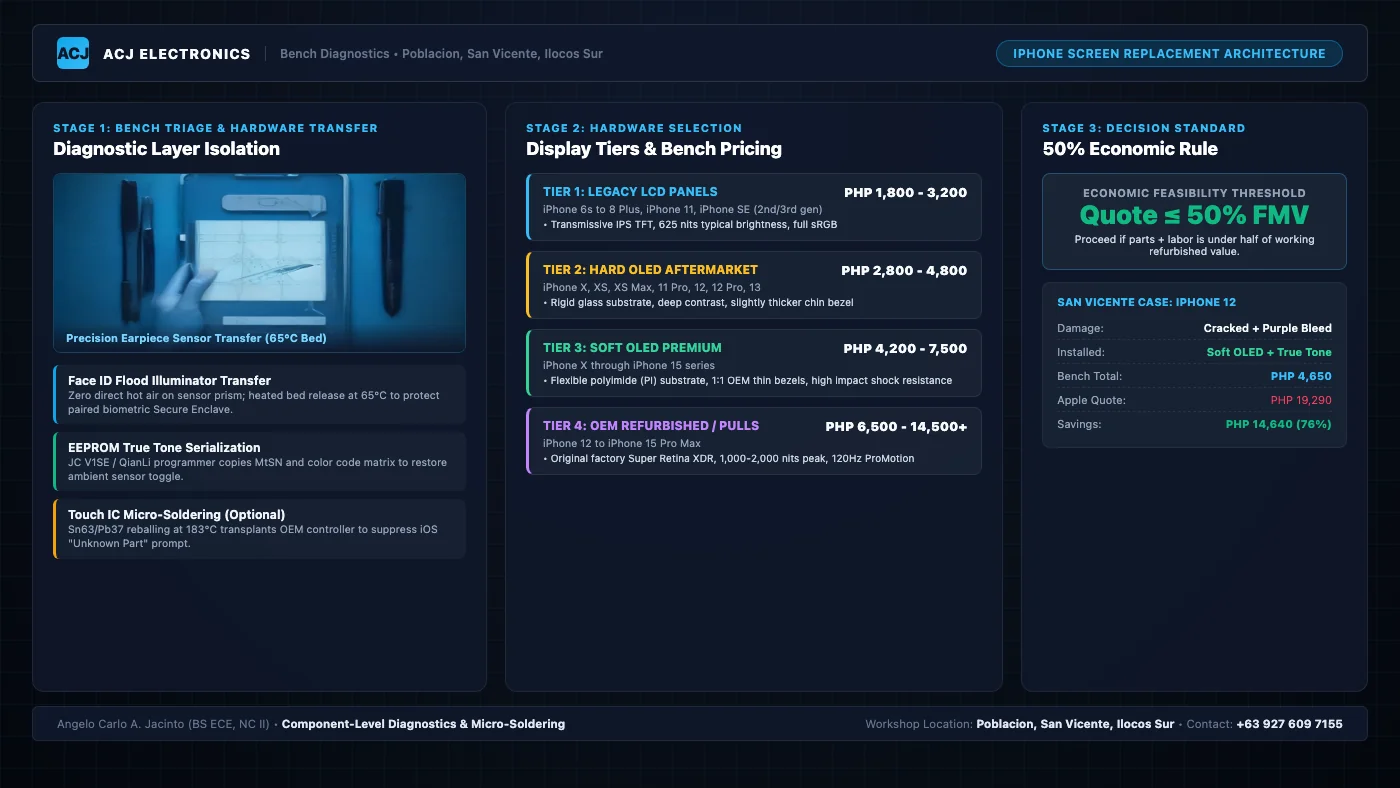
| Display Hardware Tier | Representative iPhone Models | Panel Technology and Substrate | Visual Quality and Bezel Fit | Typical Bench Range (Parts + Labor) |
|---|---|---|---|---|
| Tier 1: Legacy LCD Panels | iPhone 6s to 8 Plus, iPhone 11, iPhone SE (2nd/3rd gen) | Transmissive IPS TFT with LED backlight array | Factory-standard brightness (625 nits) and full sRGB color accuracy | PHP 1,800 to PHP 3,200 |
| Tier 2: Hard OLED Aftermarket | iPhone X, XS, XS Max, 11 Pro, 12, 12 Pro, 13 | Rigid glass substrate OLED emitter array | Deep blacks, high contrast; slightly thicker (0.5 mm) bottom chin bezel | PHP 2,800 to PHP 4,800 |
| Tier 3: Soft OLED Premium Aftermarket | iPhone X through iPhone 15 series | Flexible polyimide (PI) substrate OLED array | 1:1 OEM bezel thickness, excellent drop resilience, rich color vibrancy | PHP 4,200 to PHP 7,500 |
| Tier 4: OEM Refurbished / Original Pulls | iPhone 12 to iPhone 15 Pro Max | Original factory Apple Super Retina XDR panel | 1,000 to 2,000 nits outdoor peak brightness, 120Hz ProMotion on Pro units | PHP 6,500 to PHP 14,500+ |
Understanding Hard OLED vs Soft OLED
The choice between Hard and Soft OLED represents the most common decision for iPhone X through iPhone 14 owners. Hard OLED panels are built on an unyielding, rigid glass backing. They allow manufacturers to produce affordable OLED screens, but that rigid backing cannot curve at the bottom edge. As a result, Hard OLED screens feature a slightly thicker black bezel along the lower chin, and the glass substrate is brittle. A subsequent minor drop that would not crack the outer glass can easily shatter an internal Hard OLED matrix.
In contrast, Soft OLED panels utilize a flexible polyimide plastic substrate, mirroring Apple factory construction. The flexible substrate curves inward at the bottom connection point, enabling exact 1:1 original bezel margins. More importantly, Soft OLED absorbs mechanical shock exceptionally well, surviving routine accidental drops far better than rigid glass. For daily-use phones, we recommend Soft OLED as the ideal balance of long-term reliability and sensible pricing.
True Tone Serialization and Touch IC Micro-Soldering
Replacing an iPhone screen involves more than turning screws and snapping ribbon cables. Over successive iOS releases, Apple has implemented strict hardware serialization protocols linking display sub-components directly to the logic board.
1. Restoring True Tone via EEPROM Programmers
True Tone is Apple ambient light management system, dynamically shifting display color temperature to match room lighting. Each factory iPhone display contains a small Electrically Erasable Programmable Read-Only Memory (EEPROM) chip storing factory color matrix codes, cover glass calibration profiles, and the screen serial number (MtSN).
If a replacement screen is installed directly out of the box, iOS detects the missing calibration data and disables the True Tone toggle in Settings and Control Center. On our San Vicente workbench, we resolve this through hardware programmer serialization:
- We mount the original damaged screen onto an EEPROM programmer board (such as the JC V1SE or QianLi iCopy Plus).
- The programmer reads the unique serial strings and factory sensor tables from the original display IC.
- We connect the replacement panel and write the stored data directly into its memory chip.
- If the original screen is completely destroyed or missing, we connect the iPhone to our diagnostic terminal and read the original display serial parameters directly from the logic board NAND flash memory, flashing them to the new panel.
2. The Unknown Part Warning and Touch IC Micro-Soldering
Starting with the iPhone 11 family, Apple introduced cryptographic pairing between the touch controller integrated circuit (Touch IC) on the display flex cable and the A-series application processor. Even if you install a 100% genuine display pulled from another identical iPhone, iOS will display an “Important Display Message: Unable to determine if your iPhone display is a genuine Apple part” inside Settings.
For most users, this message is purely informational; it remains in the main Settings menu for 15 days before settling into the General About section, without impeding touch sensitivity, color accuracy, or iOS security updates. However, for customers who demand a factory-clean software status with zero system notifications, our workshop performs Touch IC micro-soldering. Under a stereo inspection microscope, we desolder or CNC grind the original encrypted touch controller chip, reball its microscopic solder array with Sn63/Pb37 alloy paste at 183°C, and solder the original chip onto a specialized aftermarket display flex designed with an open IC footprint.
Face ID Protection: Earpiece Speaker and Sensor Flex Transfer
One of the most delicate phases of an iPhone screen replacement is transferring the upper earpiece speaker assembly from the old display frame to the new one. This flexible ribbon cable houses four mission-critical components:
- The earpiece speaker audio transducer for call audio.
- The top microphone used during video recording and speakerphone calls.
- The ambient light sensor diode.
- The Face ID flood illuminator and proximity sensor module.
The flood illuminator is cryptographically paired to the Secure Enclave processor on your iPhone motherboard. Unlike a display screen or a battery, an independently damaged flood illuminator cannot be replaced with an aftermarket component without permanently disabling Face ID biometric authentication on that device.
Careless prying with metal tools or applying uncontrolled heat from a hot air rework station will delaminate the sensor prism or snap the microscopic flex traces. In our workshop, we place the shattered assembly onto a temperature-regulated 65°C heating plate for two minutes to soften the factory acrylic adhesive. We then apply drops of 99.7% electronic-grade isopropyl alcohol to dissolve remaining glue, using ultra-fine titanium tweezers to gently guide the sensor bracket out of its alignment pins without mechanical strain.
The 50% Rule: Repair vs Replacement Decision Framework
As an engineering-driven workshop, we believe in honest economic advice. We never encourage customers to pour money into an aging phone when repair costs outweigh practical device value. We follow a strict 50% economic feasibility standard:
If the total screen replacement quote (certified parts plus bench labor) exceeds 50% of the fair market value of an equivalent working refurbished iPhone, we advise against repair and recommend upgrading.
Here is how that financial guideline applies across common iPhone families in the Philippines:
- iPhone 12, 13, 14, and 15 Series: High Repair Feasibility. Refurbished market values range from ₱14,000 to over ₱35,000. Spending ₱4,200 to ₱7,500 on a premium Soft OLED replacement represents only 20% to 35% of the device value. These phones feature powerful multi-core silicon and many years of supported iOS updates, making screen repair an outstanding investment.
- iPhone X, XS, and 11 Series: Borderline Feasibility. Market values sit between ₱7,000 and ₱11,000. An affordable LCD or Hard OLED repair at ₱2,500 to ₱3,500 makes sound sense if the rest of the phone is healthy. However, if the rear glass is shattered and battery health is below 75%, total refurbishment costs quickly breach 50%.
- iPhone 7, 8, and Older Models: Upgrade Recommended. With second-hand market values hovering under ₱4,000 and operating system update support phased out, spending ₱2,000 or more on a screen is rarely economical unless the device holds irreplaceable data that was never backed up to iCloud.
For a wider perspective on assessing aging gadgets, explore our detailed guides on the Electronics Repair Pricing Hub and the Repair vs Replace Hub.
San Vicente Workshop Bench Case: iPhone 12 Soft OLED Restoration
To demonstrate how this triage process works on a daily workbench, consider a recent customer intake at our Poblacion, San Vicente shop. An iPhone 12 (64GB Black) was brought in after taking a direct impact onto concrete curb stones.
Initial Bench Inspection: The front cover glass was shattered in spiderweb patterns across the top left corner. When powered on, the OLED display revealed a bright vertical green line alongside an expanding purple ink blot that had blinded the numerical passcode pad. Touch input was erratic across the upper half of the screen. However, connecting the phone to our USB power analyzer verified standard 5.1V charging at 1.4A, and incoming test calls rang normally through the vibration motor.
Repair Procedure:
- The technician warmed the perimeter on a 65°C heating bed and opened the chassis from the right edge, immediately disconnecting the lithium-ion battery flex to prevent short circuits.
- The original broken display was plugged into our QianLi iCopy programmer, successfully copying the MtSN serial string and True Tone calibration data.
- The upper earpiece speaker and sensor flex was loosened with isopropyl alcohol and lifted without disturbing the Face ID flood illuminator prism.
- A premium Soft OLED panel was flashed with the stored True Tone data, and the original sensor flex was seated into precision alignment brackets on the new frame.
- A fresh die-cut water-resistant perimeter gasket was applied to the aluminum chassis, and the screen was pressed into place under uniform clamp pressure.
Repair Outcome and Financials: Total turnaround time was 45 minutes. True Tone ambient color matching operated smoothly, multi-touch input was 100% verified across all grid squares, and Face ID unlocked instantly. The complete service cost the customer ₱4,650. In contrast, an authorized service center display replacement quote stood at ₱19,290. The customer saved ₱14,640 while leaving the workshop with an intact, fully functioning iPhone.
Professional iPhone Diagnostics in San Vicente, Ilocos Sur
If your iPhone has a cracked screen, erratic touch input, or a blank display, professional component-level testing ensures you pay only for what your device actually needs. From simple front glass renewals to complex logic board display power rail troubleshooting, our bench is equipped with digital programmers, microscopes, and certified replacement panels.
To explore related diagnostic workflows, consult our guides on water damaged phone repair and Android battery replacement cost in the Philippines, review our professional toolkit on the Tools and Skills Hub, or explore our full smartphone service offerings on the Phone Repair Hub and the services directory.